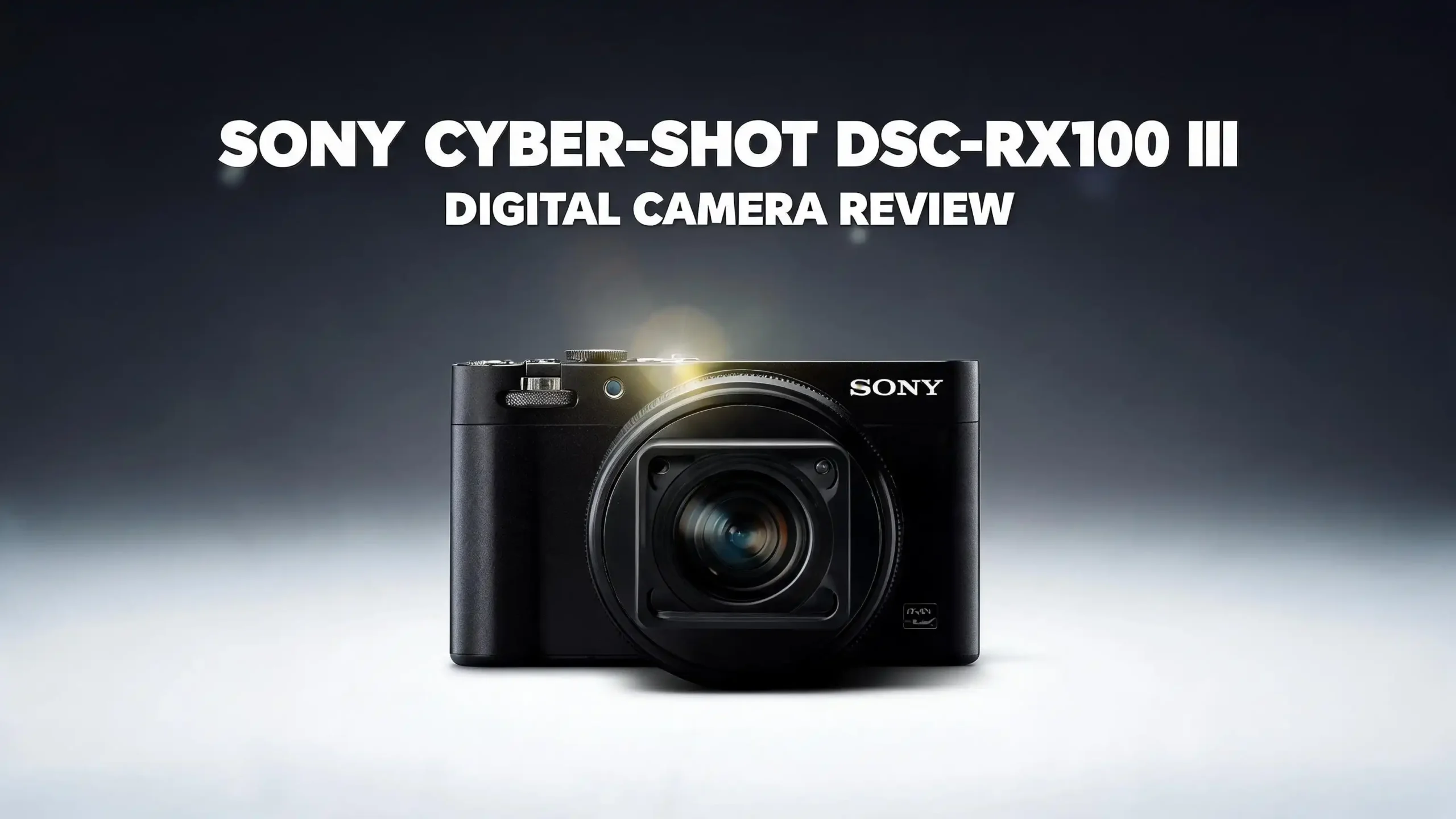
Sony Cyber-shot DSC-RX100 III Digital Camera Review 2026: Worth Buying?
The Sony Cyber-shot DSC-RX100 III still earns attention in 2026. This pocket sized camera packs a one inch sensor and a bright Zeiss lens. Many photographers still pick it over newer models because it delivers strong image quality at a friendly price.
You can slip it into a jacket pocket. You can shoot sharp photos in low light. You can also record smooth Full HD video.
This review covers every important detail. You will learn about the build, the lens, the sensor, the autofocus, the battery, and the video features.
You will also see how it compares to popular rivals like the Sony RX100 VII and the Canon G7X Mark III. By the end, you will know if the RX100 III fits your needs today.
Key Takeaways
- Pocket sized power: The RX100 III holds a one inch 20.1 megapixel sensor inside a body that weighs only 290 grams. It easily slips into a pocket.
- Bright Zeiss lens: The 24mm to 70mm f/1.8 to f/2.8 zoom gives you sharp shots and smooth background blur. It works well in dim rooms.
- Pop up electronic viewfinder: A 1.44 million dot OLED EVF hides inside the body and pops up when you need it. This feature is rare in compact cameras.
- Tilting selfie screen: The 3 inch LCD tilts 180 degrees up. This makes it great for vlogs, selfies, and creative angles.
- Excellent value in 2026: Used and refurbished units sell at strong prices. The RX100 III still beats most phone cameras for image quality, zoom, and manual control.
- Some limits: It lacks 4K video, touch screen, and the long zoom of newer RX100 models.
Sony Cyber-shot DSC-RX100 III Overview

- Digital Zoom - 5.8
- Video Capture Resolution - FHD 1080p
Last update on 2026-07-19 / Affiliate links / Images from Amazon Product Advertising API
The Sony RX100 III launched in 2014. It quickly became a favorite among travel photographers and street shooters. Even today, it stays popular because Sony built it with quality parts and smart design choices. The body uses solid aluminum. The lens carries the famous Zeiss Vario Sonnar T name.
This camera fits in the third spot of the RX100 line. Sony improved the lens range from the older models. The new 24mm to 70mm zoom opens wider for more light. The maker also added a pop up electronic viewfinder. This was a big deal because no compact camera at this size had one before.
You get full manual control. You can shoot in RAW format. You can adjust shutter speed, aperture, and ISO with ease. The control ring around the lens makes quick changes simple. The RX100 III gives you DSLR style control in a pocket sized body. That mix keeps it relevant well into 2026.
Design and Build Quality
The RX100 III feels solid in the hand. Sony built the shell from aluminum, not plastic. This gives it a premium feel and good durability. The body measures about 102 by 58 by 41 millimeters. It weighs 290 grams with the battery and card. You can carry it all day without feeling tired.
The front face stays smooth and flat. Some users add a small stick on grip to improve handling. The top of the camera holds the mode dial, shutter button, zoom ring, and power switch. The buttons feel firm and responsive. Nothing wobbles or rattles.
The pop up flash and pop up EVF sit on the left side of the top plate. You push a switch to raise the EVF. You then pull the eyepiece back to focus. This two step action feels a bit clunky at first. After a week of use, it becomes second nature. The clean design and strong build help the RX100 III look fresh even after years of use.
The One Inch Sensor and Image Quality
The heart of the RX100 III is a 20.1 megapixel one inch Exmor R BSI CMOS sensor. This sensor is much larger than what you find in any smartphone. A bigger sensor means more light, better detail, and less noise. The Bionz X processor handles the data and produces clean JPEG and RAW files.
Photos look sharp from edge to edge. Colors look natural and pleasing right out of the camera. Skin tones come out smooth and accurate. The dynamic range covers about 12.3 stops at base ISO. This lets you recover shadows and highlights in editing without losing detail.
Low light performance is strong for a compact camera. You can shoot at ISO 1600 with little noise. ISO 3200 still looks clean enough for social media and small prints. Above ISO 6400, grain becomes more visible, but files stay usable. For a camera that fits in your pocket, the image quality remains impressive in 2026.
The Bright Zeiss 24 to 70mm Lens
The Zeiss Vario Sonnar T 24mm to 70mm f/1.8 to f/2.8 lens is the star feature. This is a useful range for most situations. The 24mm wide end is great for landscapes, interiors, and group photos. The 70mm short tele end works well for portraits and close ups.
The bright aperture lets in plenty of light. At f/1.8, you get a shallow depth of field and beautiful background blur. This effect is hard to match with a smartphone. The lens stays sharp across the frame even wide open. Corners hold up well, and there is little chromatic aberration.
The lens also includes optical image stabilization. This helps you shoot handheld in low light. You can use slower shutter speeds and still get sharp pictures. The T coating reduces flare and ghosting in bright scenes. The Zeiss lens is one big reason the RX100 III still feels modern in 2026.
Top 3 Alternatives for Sony Cyber-shot DSC-RX100 III
If you want something different, these three cameras are strong choices in 2026. Each one offers features that the RX100 III lacks, like 4K video, longer zoom, or a touch screen.

- 20. 1MP 1. 0 Type stacked CMOS sensor, Zeiss Vario Sonnar T 24 200 millimeter F2. 8 F4. 5 large aperture high...
- 0. 02 sec. High AF speed, 357 point focal plane Phase detection AF and 425 point contrast detection AF

Last update on 2026-07-19 / Affiliate links / Images from Amazon Product Advertising API
The Sony RX100 VII gives you a much longer 24mm to 200mm zoom. It adds 4K video, fast tracking autofocus, and a microphone jack. This is the best choice for vloggers and wildlife shooters who want a pocket camera.

- Canon PowerShot G7 X Mark III(International Version)- 20.2MP 1" Stacked CMOS Sensor, DIGIC 8 Image Processor, 4.2x...
- Large 20.1MP 1" stacked CMOS sensor, along with a DIGIC 8 image processor, the G7 X Mark III offers notable imaging...
Last update on 2026-07-19 / Affiliate links / Images from Amazon Product Advertising API
The Canon PowerShot G7X Mark III offers a touch screen, 4K video, and live YouTube streaming. The colors look warm and natural. It is a top pick for content creators and casual users.

- POINT-AND-SHOOT CAMERA: Large, 1-inch 20.1-megapixel MOS sensor plus 3X zoom LEICA DC VARIO-SU millimeter ILUX lens...
- TILTING SELFIE DISPLAY: Rear touch-enabled 3-inch LCD display (1040K dots) tilts upward 180 degrees for easy selfie...
Last update on 2026-07-19 / Affiliate links / Images from Amazon Product Advertising API
The Panasonic Lumix LX10 has a bright f/1.4 to f/2.8 Leica lens and 4K video. It also includes a touch screen with focus tap. It costs less than the RX100 III in many shops in 2026.
Pop Up Electronic Viewfinder
The pop up EVF is one of the most loved features of the RX100 III. It holds a 1.44 million dot OLED panel. The image looks bright, sharp, and detailed. You can compose shots in bright sunlight when the rear screen washes out. You also get a steadier hold when the camera sits against your face.
The EVF pops up from the top left corner with a flick of a switch. You then pull the eyepiece back to lock it in shooting position. Some users find this step slow. With practice, it takes only one second.
The eye sensor turns the EVF on as soon as you raise the camera to your eye. The rear screen turns off at the same time. This saves battery and keeps the workflow smooth. Few compact cameras still offer a built in EVF, which makes the RX100 III special even in 2026.
Tilting LCD Screen for Selfies and Vlogs
The 3 inch rear LCD has 1,228,800 dots. It tilts up 180 degrees and down 45 degrees. When you flip it up, you can frame yourself for selfies and vlogs. This made the RX100 III a favorite among early YouTubers and travel bloggers.
The screen is sharp and bright. You can see your shots clearly indoors and in moderate sunlight. In very bright sun, you may want to use the EVF instead. The screen does not support touch input. This means you must use the rear buttons to change settings and pick focus points.
The lack of a touch screen feels old in 2026. Most modern cameras and phones use touch by default. Still, the physical buttons feel fast and reliable once you learn the layout. The flip up screen alone makes the RX100 III a strong pick for self filming and creative low angle shots.
Autofocus Performance
The RX100 III uses a 25 point contrast detection autofocus system. It does not have on sensor phase detection. The AF still feels quick and accurate for stills. The camera locks focus in about 0.2 seconds in good light. Even in dim rooms, it finds focus without much hunting.
Face detection works well for portraits. The camera tracks faces around the frame and adjusts focus on the fly. Eye AF is also built in. You hold a button to lock focus on the closest eye. This helps you nail sharp portraits every time.
For moving subjects, the autofocus has limits. Fast action like sports and birds in flight can confuse the system. Newer RX100 models with phase detection do a much better job here. For travel, street, and casual shooting, the RX100 III autofocus still gets the job done well in 2026.
Video Capabilities
The RX100 III records Full HD 1080p video at up to 60 frames per second. It also offers 720p at 120fps for slow motion clips. Video quality looks clean, sharp, and well exposed. The XAVC S codec at 50Mbps gives smooth footage with low compression artifacts.
The bright lens and one inch sensor help with low light video. You get nice background blur and natural skin tones. The optical image stabilization smooths out hand held clips. There is no microphone jack, so you must use the built in mic or record audio on a separate device.
The biggest miss is the lack of 4K video. By 2026, 4K has become standard even on cheap cameras and phones. If you only need Full HD, the RX100 III still produces great looking video. For 4K, you need to step up to the RX100 IV or newer models.
Manual Controls and Shooting Modes
The RX100 III gives you full manual control. You get PASM modes on the dial. You can also use Memory Recall, Movie, and Auto modes. The lens has a smooth control ring that you can map to aperture, shutter speed, ISO, or zoom. This feels like a real camera, not a point and shoot.
The Fn button opens a quick menu with 12 settings. You can choose what shows up here. This makes fast changes simple in the field. The rear dial and buttons handle most other tasks. The custom button system lets you tune the camera to your style.
The camera also supports exposure bracketing, time lapse via the PlayMemories app, and panorama mode. RAW shooters get 14 bit ARW files for full editing freedom. The deep control set keeps the RX100 III useful for serious photography even in 2026.
Battery Life and Storage
The RX100 III uses the NP BX1 battery. Sony rates it for about 320 shots per charge. In real use, you may get a bit more or less based on your habits. Heavy EVF use, video, and Wi Fi will drain the battery faster. Light shooters can stretch a charge over a full day of travel.
The good news is that you charge the battery inside the camera over USB. This makes it easy to top up from a power bank, a laptop, or a car charger. Most owners buy a spare battery or two for long trips. Spare batteries are cheap and easy to find online.
The RX100 III takes one SD, SDHC, or SDXC card. It also supports Sony Memory Stick. A 64GB card holds plenty of RAW files and Full HD clips. Battery life is the weakest spot of the RX100 III, but spare cells solve the issue.
Connectivity and Wireless Features
The RX100 III has built in Wi Fi and NFC. You can connect to your phone using the Sony Imaging Edge Mobile app. The app lets you send photos to your phone, control the camera remotely, and add GPS data. The setup is quick if you have used Sony apps before.
The remote shooting feature is handy for tripod work, group photos, and wildlife. You see a live view on your phone screen. You can change settings and fire the shutter from a distance. This is helpful for vlogs and self portraits.
The camera lacks Bluetooth, which means no always on link to your phone. You must open the app and connect each time you want to transfer files. USB 2.0 and micro HDMI ports handle wired connections. The wireless features feel basic in 2026, but they still work well for casual sharing.
Real World Performance and Use Cases
The RX100 III shines for travel, street, and family photography. The small size means you take it everywhere. You catch moments that you would miss with a bigger camera. The bright lens handles cafes, sunsets, and indoor events without a flash. The quiet shutter does not draw attention on the street.
For portraits, the f/1.8 aperture at 24mm and f/2.8 at 70mm gives pleasing background blur. Skin tones look natural straight from the camera. For landscapes, the 24mm wide end and sharp lens capture wide scenes with rich detail. RAW files give you room to edit later.
Vloggers still pick the RX100 III for its flip up screen and clean Full HD video. Some food bloggers and Instagram users love the close focus distance of 5 centimeters at the wide end. In 2026, the RX100 III remains a smart pick for anyone who wants a real camera in their pocket.
Price and Value in 2026
The Sony RX100 III is no longer the newest model in the line. This works in your favor. Prices have dropped, and many shops sell refurbished or used units in great shape. New stock still appears on Amazon and Sony resellers at fair prices.
You get a lot of camera for the money. The one inch sensor, the Zeiss lens, the EVF, and the flip screen would cost much more in a newer model. For under the cost of a mid range phone, you get a serious tool for photography. That value is hard to beat in 2026.
If you have a small budget, the used market is your friend. Look for clean copies from trusted sellers. Always check the shutter count and lens action before you buy. The RX100 III gives you a premium compact camera at a midrange price in 2026.
Pros and Cons Summary
The RX100 III has many strong points and a few weak spots. On the plus side, you get great image quality, a bright zoom lens, a pop up EVF, a flip screen, full manual control, and a small body. The build feels premium. The colors look natural. The lens is sharp at all focal lengths.
On the down side, there is no 4K video, no touch screen, no microphone jack, and no weather sealing. Battery life is short. The zoom range stops at 70mm, which feels tight for some users. The autofocus cannot match newer phase detection systems for fast action.
For most users, the strengths far outweigh the weaknesses. The RX100 III still earns a spot in many camera bags in 2026. If you can live with Full HD video and a short zoom, this camera will not let you down.
Final Verdict: Is the Sony RX100 III Worth Buying in 2026?
Yes, the Sony Cyber-shot DSC-RX100 III is still worth buying in 2026 for many people. It is a smart pick if you want a pocket camera with real photo quality. The one inch sensor and Zeiss lens deliver shots that crush most phones. The EVF and flip screen add real value. The lower price compared to newer RX100 models makes it a smart buy.
It is not the right pick if you need 4K video, long zoom, a touch screen, or pro level autofocus. In those cases, look at the Sony RX100 VII, Canon G7X Mark III, or Panasonic LX10 instead. Each one fills a gap that the RX100 III leaves.
For travel photographers, street shooters, casual vloggers, and anyone who wants better photos than a phone, the RX100 III remains a top compact camera choice in 2026. Buy with confidence and enjoy the small body, big sensor magic that made this camera famous.
Frequently Asked Questions
Is the Sony RX100 III still worth buying in 2026?
Yes, the RX100 III is still worth buying in 2026. It has a one inch sensor, a bright Zeiss zoom lens, and a pop up EVF. Prices have dropped, which makes it a great value. It beats most phone cameras for image quality, manual control, and low light shots.
Does the Sony RX100 III shoot 4K video?
No, the RX100 III does not shoot 4K video. It records Full HD 1080p at up to 60 frames per second. If you need 4K, look at the Sony RX100 IV, V, VI, VII, or the Canon G7X Mark III instead.
How long does the Sony RX100 III battery last?
The NP BX1 battery is rated for about 320 shots per charge. Heavy EVF, video, and Wi Fi use will drain it faster. Most owners carry one or two spare batteries for longer outings.
Can I use the Sony RX100 III for vlogging?
Yes, the flip up screen and clean Full HD video make the RX100 III a solid vlogging camera. It lacks a microphone jack and 4K video. If those matter to you, pick the Sony RX100 VII or Canon G7X Mark III.
What memory card works best with the RX100 III?
The RX100 III takes SD, SDHC, and SDXC cards. A UHS I Class 10 card with 64GB or 128GB works well for both photos and Full HD video. SanDisk Extreme and Sony Tough cards are popular and reliable choices.
Is the Sony RX100 III better than a smartphone camera?
Yes, the RX100 III beats most smartphones for image quality. The one inch sensor is much larger than any phone sensor. You get better low light shots, real optical zoom, sharper detail, and natural background blur. RAW shooting gives you more editing freedom too.
Does the Sony RX100 III have a touch screen?
No, the RX100 III does not have a touch screen. You use the physical buttons and dials to change settings and pick focus points. The controls feel fast once you learn the layout, but the lack of touch feels old in 2026.

Hi, I’m Emma! I’m that friend who always gets asked “Should I buy this gadget?” – and I love it. After years of being the unofficial tech advisor for family, friends, and coworkers, I realized I had a knack for cutting through marketing hype to find what actually works.