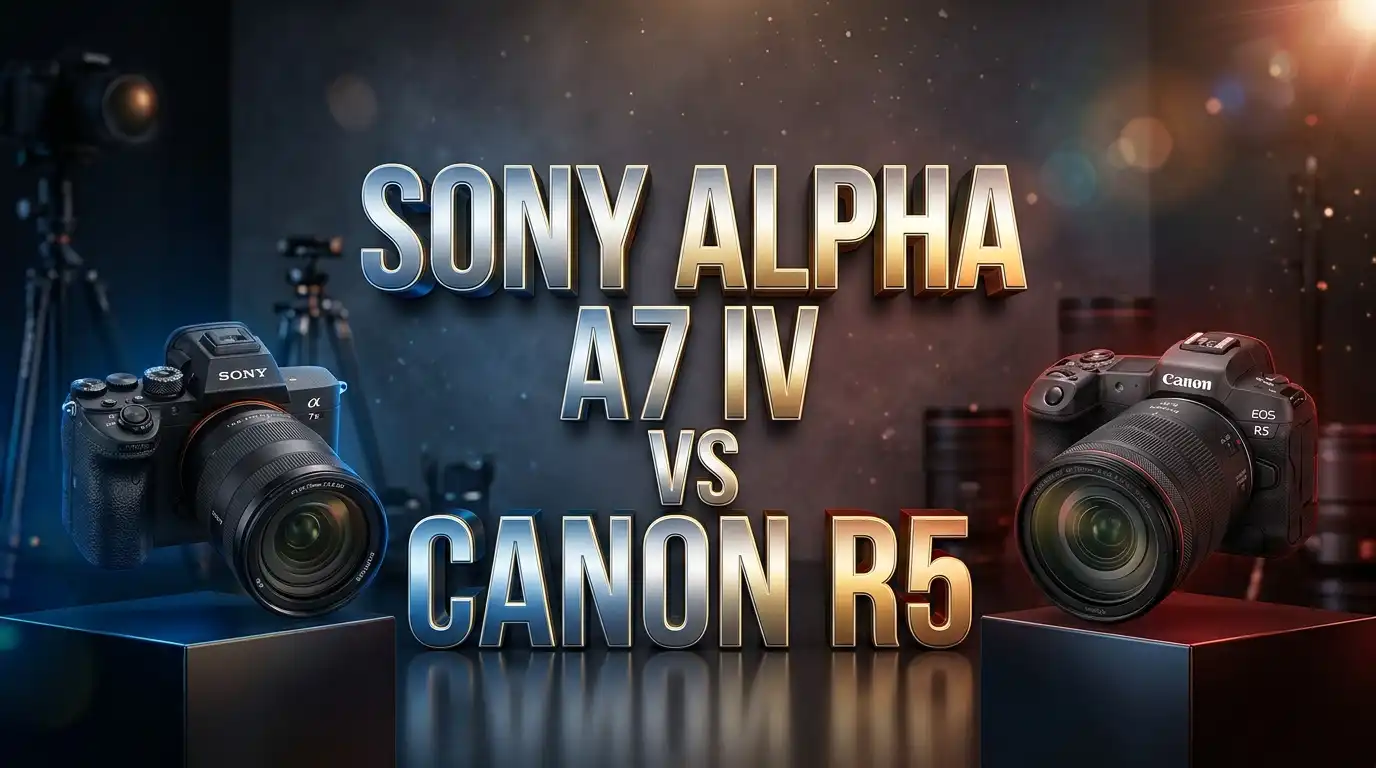
Sony Alpha A7 IV vs Canon R5: Which Is The Best?
Choosing between the Sony Alpha A7 IV and the Canon EOS R5 is one of the toughest decisions a photographer or videographer can face right now. Both cameras come from industry giants.
Both deliver stunning image quality. And both have loyal fan bases that will argue all day about which one is better.
So which one should you buy? That depends on your shooting style, budget, and the features that matter most to you.
In this detailed comparison, we break down every major aspect of both cameras. We cover sensors, autofocus, video, battery life, ergonomics, and much more.
Key Takeaways
- The Canon R5 offers 45 megapixels compared to the Sony A7 IV’s 33 megapixels. This gives the R5 a clear edge in resolution for large prints and heavy cropping.
- The Sony A7 IV delivers far better battery life at 580 shots per charge versus the Canon R5’s 320 shots. This makes the A7 IV more reliable for long shooting days without carrying extra batteries.
- The Canon R5 shoots 8K video at 30fps and 4K at 120fps, while the Sony A7 IV maxes out at 4K 60p. Video professionals who need the highest resolution footage will prefer the R5.
- The Sony A7 IV costs significantly less than the Canon R5, often saving buyers over $1,000. That extra money can go toward quality lenses or accessories.
- The Canon R5 has 5,940 autofocus points versus the Sony A7 IV’s 759 points. The R5 also shoots at 20fps compared to the A7 IV’s 10fps, making it better for fast action and wildlife photography.
- The Sony A7 IV weighs 80 grams less and has a BSI (back-illuminated) sensor that performs slightly better in low light according to DxOMark scores. It also features a built-in stereo microphone for better audio capture.
Sony Alpha A7 IV Overview

- 33MP full-frame Exmor R back-illuminated CMOS sensor.Operating temperature : 0 to 40 °C (32 to 104 °F), Rated input...
- 8x more powerful, next generation BIONZ XR image processing engine

Last update on 2026-08-06 / Affiliate links / Images from Amazon Product Advertising API
The Sony Alpha A7 IV launched in October 2021 as the successor to the popular A7 III. Sony calls it the “new basic” of full-frame cameras. It packs a 33-megapixel back-illuminated Exmor R CMOS sensor paired with the Bionz XR processor. This combination delivers excellent image quality and fast processing speeds.
The A7 IV uses 759 phase-detection autofocus points that cover about 94% of the image area. It tracks eyes, faces, and animals with impressive accuracy. The camera shoots continuously at 10 frames per second with the mechanical shutter.
For video, the A7 IV records 4K at 60fps in 10-bit 4:2:2 color. It supports S-Cinetone color profiles borrowed from Sony’s cinema line. The camera also features a fully articulating touchscreen, a built-in stereo microphone, and a CFexpress Type A / SD card dual slot system.
Pros:
- Excellent price-to-performance ratio
- 580-shot battery life is among the best in class
- BSI sensor delivers strong low-light results
- Built-in stereo microphone
- Lightweight at 658 grams
Cons:
- Limited to 10fps continuous shooting
- No 8K video recording
- Single UHS-II SD card slot (second slot is CFexpress Type A)
- 4K 60p has a slight crop
Canon EOS R5 Overview

- High Image Quality: Canon EOS R5 8K digital camera features a stacked, back-side illuminated 45-megapixel full-frame...
- Powerful Image Processor: DIGIC X image processor with an ISO range of 100-51200; expandable to 102400x; powers 8K...
Last update on 2026-08-06 / Affiliate links / Images from Amazon Product Advertising API
The Canon EOS R5 arrived in July 2020 and quickly became Canon’s flagship mirrorless camera. It features a 45-megapixel full-frame CMOS sensor powered by the DIGIC X processor. This camera was built for professionals who need both high resolution and blazing speed.
The R5 boasts an incredible 5,940 autofocus points using Canon’s Dual Pixel CMOS AF II system. It tracks people, animals, and vehicles with remarkable precision. The continuous shooting speed reaches 20 frames per second with the electronic shutter and 12fps with the mechanical shutter.
On the video side, the R5 records 8K RAW at 30fps and 4K at 120fps in 10-bit. This makes it one of the most capable video cameras in its class. The body features a 3.2-inch touchscreen with 2.1 million dots, dual card slots (CFexpress Type B and SD UHS-II), and 8-stop in-body image stabilization.
Pros:
- 45MP sensor captures incredible detail
- 5,940 AF points with advanced subject tracking
- 20fps burst shooting speed
- 8K and 4K 120p video recording
- 8-stop image stabilization
Cons:
- Overheating issues during extended 8K and 4K HQ video recording
- Battery life limited to 320 shots per charge
- Heavier body at 738 grams
- Significantly higher price point
Sensor and Image Quality Comparison
The sensor is the heart of any camera. The Canon R5 uses a 45-megapixel CMOS sensor that produces images with 8192 x 5464 pixel resolution. The Sony A7 IV uses a 33-megapixel BSI-CMOS sensor that outputs 7008 x 4672 pixel images.
The R5’s higher megapixel count gives it a clear advantage for large-format prints and aggressive cropping. Photographers who shoot landscapes, studio portraits, or commercial work will appreciate those extra 12 megapixels.
However, the Sony A7 IV’s back-illuminated sensor design gives it a slight edge in low-light performance. DxOMark rates the A7 IV’s low-light ISO score at 3,379 compared to the R5’s 3,042. This means the A7 IV produces slightly cleaner images at high ISO values.
Both cameras deliver outstanding dynamic range and color accuracy. The difference in real-world image quality between these two sensors is small for most shooting situations. Your choice here depends on whether you value resolution or low-light performance more.
Autofocus Performance
Autofocus can make or break a camera, especially for action and event photography. The Canon R5 dominates this category with its 5,940 selectable AF points. The Sony A7 IV offers 759 phase-detection AF points. Both systems cover nearly the entire sensor area.
The R5’s Dual Pixel CMOS AF II system tracks subjects with exceptional speed and accuracy. It recognizes and tracks people, animals, birds, and vehicles. The system works reliably even in challenging lighting conditions down to -6 EV.
The Sony A7 IV’s autofocus system is also highly capable. It uses a hybrid system combining phase-detection and contrast-detection points. The A7 IV tracks human eyes, animal eyes, and bird eyes very effectively. Sony’s real-time tracking algorithm is fast and sticky once it locks onto a subject.
For sports, wildlife, and fast-moving subjects, the Canon R5 has the edge due to its higher AF point count and faster burst rate. For everyday shooting, portraits, and events, both cameras perform exceptionally well.
Video Capabilities
Video is a major battleground between these two cameras. The Canon R5 offers 8K RAW recording at 30fps and 4K at 120fps with 10-bit color depth. The maximum recording bitrate reaches an impressive 2,600 Mbps.
The Sony A7 IV records 4K at 60fps in 10-bit 4:2:2 with a maximum bitrate of 600 Mbps. It also supports S-Cinetone, Sony’s popular color profile that produces natural skin tones and pleasing color straight out of the camera.
The R5 wins on raw video specs. But there is a catch. The R5 suffers from overheating during long recording sessions, especially in 8K and 4K HQ modes. Canon has improved this through firmware updates, but it remains a real-world limitation for extended shoots.
The A7 IV runs cooler and more reliably during long video sessions. It also features a fully articulating screen that flips out to the side, which is more practical for solo vlogging and self-recording. Content creators who prioritize recording reliability over maximum resolution will prefer the A7 IV.
Burst Shooting Speed
Speed matters for sports, wildlife, and event photographers. The Canon R5 shoots at 20fps with the electronic shutter and 12fps with the mechanical shutter. The Sony A7 IV shoots at 10fps with both shutter types.
The R5’s 20fps burst rate combined with its 5,940 AF points makes it a formidable action camera. It can track fast-moving subjects like birds in flight or athletes on the field with great consistency.
The A7 IV’s 10fps burst rate is respectable and sufficient for most event and portrait photography. However, it falls behind the R5 for demanding action scenarios. If you regularly photograph fast sports or wildlife, the R5 delivers a noticeably better hit rate.
The R5 also has a deeper buffer, allowing it to shoot more consecutive frames before slowing down. This is a significant advantage during fast-paced shooting sequences where every frame counts.
Image Stabilization
Both cameras feature in-body image stabilization (IBIS) using sensor-shift technology. The Canon R5 offers up to 8 stops of stabilization when paired with compatible RF lenses. The Sony A7 IV provides up to 5.5 stops of stabilization.
That 2.5-stop difference is significant in real-world use. The R5’s superior stabilization allows you to shoot handheld at much slower shutter speeds and still get sharp results. This is especially useful for landscape photography, low-light handheld work, and video recording.
The A7 IV’s 5.5-stop IBIS is still very effective for general photography. Most users will get sharp handheld shots at standard focal lengths. However, at longer focal lengths or in very dim conditions, the R5’s 8-stop system gives it a clear advantage.
For video shooters, better IBIS means smoother handheld footage without relying on heavy gimbals. The R5 produces noticeably steadier video during walking and movement.
Battery Life
Battery life is one area where the Sony A7 IV wins decisively. The A7 IV delivers 580 shots per charge using the NP-FZ100 battery with a 2,280 mAh capacity. The Canon R5 manages only 320 shots per charge using the LP-E6NH battery with 2,130 mAh capacity.
That is a difference of 260 shots, which is massive for a full day of shooting. Wedding photographers, travel shooters, and event professionals will feel this difference. With the A7 IV, you can often get through a full session on a single battery. With the R5, you will likely need at least one spare.
The R5’s lower battery life is partly due to its higher resolution sensor, faster processor, and power-hungry features like 8K recording and the high-resolution rear screen. Both cameras support USB-C charging, so you can top up between sessions using a power bank.
If battery life is a priority for your workflow, the Sony A7 IV is the clear winner here.
Build Quality and Ergonomics
Both cameras feature weather-sealed magnesium alloy bodies built to withstand dust and moisture. The Canon R5 weighs 738 grams while the Sony A7 IV weighs 658 grams. The 80-gram difference is noticeable during long shooting sessions.
The Canon R5 has a slightly larger 3.2-inch rear screen with 2.1 million dots. The Sony A7 IV has a 3.0-inch screen with 1.04 million dots. The R5’s screen is sharper and easier to review images on in bright sunlight.
The A7 IV features a fully articulating screen that flips out to the side. The R5 also has a vari-angle touchscreen. Both designs work well for video creators. Sony’s menu system has improved significantly with the A7 IV, making it more intuitive than older Sony cameras.
Canon’s ergonomics have always been praised. The R5 has a deep, comfortable grip and well-placed controls. The A7 IV also offers a solid grip, though some users with larger hands may prefer Canon’s slightly bigger body.
Connectivity and Storage
The Sony A7 IV uses USB 3.2 for fast data transfer and tethered shooting. Both cameras support Wi-Fi 5 (802.11ac) and Bluetooth for wireless connectivity.
The Canon R5 uses Bluetooth 5.0 while the Sony A7 IV uses Bluetooth 4.1. The newer Bluetooth version on the R5 offers faster pairing and better power efficiency for wireless connections.
For storage, the Canon R5 uses a CFexpress Type B slot and an SD UHS-II slot. The Sony A7 IV features a CFexpress Type A slot and an SD UHS-II slot. CFexpress Type B cards are faster and more widely available than Type A cards. However, Type A cards are smaller and more versatile since the A7 IV’s slot accepts both Type A and SD cards.
Both cameras support dual card recording for backup and overflow. Professional photographers who need data redundancy will appreciate this feature on both bodies.
Lens Ecosystem
The Canon RF mount and the Sony E mount both offer extensive lens lineups. Sony’s E-mount system has been around since 2010 and has a larger selection of native lenses from Sony and third-party manufacturers like Sigma, Tamron, and Samyang.
Canon’s RF mount launched in 2018 and has grown rapidly. Canon produces excellent RF lenses with advanced optical designs. However, Canon has been more restrictive with third-party lens licensing, although this has started to change.
Both systems offer lenses for every shooting scenario. You will find fast primes, professional zooms, macro lenses, and super-telephoto options in both mounts.
If you already own lenses from either system, staying within your current ecosystem makes the most financial sense. If you are starting fresh, both systems will serve you well for years to come.
Price and Value
Price is a major factor in this comparison. The Sony A7 IV body retails for around $2,498. The Canon R5 body retails for around $3,899. That is a price difference of roughly $1,400.
The A7 IV delivers outstanding value for its price. It offers a modern sensor, reliable autofocus, excellent 4K video, and strong battery life. For most photographers and videographers, it provides everything they need at a lower cost.
The Canon R5 justifies its higher price with more megapixels, faster burst rates, more AF points, 8K video, and superior IBIS. If you need these professional features, the R5 is worth the investment.
However, the money you save with the A7 IV could buy you a high-quality lens that dramatically improves your photography. Think about your total system cost, not just the body price, before making your decision.
Who Should Buy the Sony Alpha A7 IV?
The Sony A7 IV is ideal for hybrid creators who shoot both photos and videos regularly. It suits wedding photographers, content creators, vloggers, and travel photographers who need reliable performance all day long.
If you value battery life and portability, the A7 IV is the better choice. Its lighter body and longer battery make it easier to carry and shoot with for hours. The fully articulating screen and built-in stereo microphone add practical benefits for solo video creators.
Budget-conscious photographers will also appreciate the A7 IV. It delivers professional-level results without the premium price of the R5. The money saved can be invested in quality glass, which often matters more than the camera body itself.
Who Should Buy the Canon EOS R5?
The Canon R5 is built for professionals who demand maximum resolution, speed, and video quality. Wildlife photographers, sports shooters, and commercial professionals will benefit most from its 45MP sensor and 20fps burst rate.
If you need 8K video or 4K at 120fps, the R5 is one of few cameras that deliver this at its price point. Videographers working on high-end productions will find its video specs extremely valuable.
Photographers who print large and crop aggressively will love the extra megapixels. The R5’s superior IBIS also makes it excellent for handheld shooting in difficult conditions. If performance is your top priority, the R5 delivers.
Final Verdict: Sony A7 IV vs Canon R5
Both the Sony Alpha A7 IV and the Canon EOS R5 are outstanding cameras. The right choice depends on your specific needs and budget. The A7 IV offers better value, longer battery life, and lighter weight. The R5 delivers higher resolution, faster speed, and superior video specs.
For most enthusiasts and hybrid creators, the Sony A7 IV offers the best overall package. For professionals who need flagship performance and can handle the higher price, the Canon R5 is a worthy investment.
Neither choice is wrong. Both cameras will produce stunning images and video in the right hands.
FAQs
Is the Sony A7 IV better than the Canon R5?
The answer depends on your priorities. The Sony A7 IV is better for value, battery life, and lightweight shooting. The Canon R5 is better for resolution, speed, and advanced video. Neither camera is universally better than the other.
Can the Canon R5 record 8K video without overheating?
The Canon R5 can record 8K video, but it does experience overheating during extended sessions. Canon has released firmware updates that improved recording times. Short 8K clips are generally fine, but continuous recording beyond 20 minutes may trigger thermal limits depending on ambient temperature.
Is the Sony A7 IV good for professional photography?
Yes. The Sony A7 IV is absolutely good for professional photography. Its 33MP sensor, 759 AF points, and reliable performance make it suitable for weddings, events, portraits, and commercial work. Many working professionals use the A7 IV as their primary camera.
Which camera has better autofocus, the A7 IV or R5?
The Canon R5 has a more advanced autofocus system with 5,940 AF points compared to the A7 IV’s 759 points. The R5 also tracks a wider range of subjects including vehicles. However, both cameras deliver excellent autofocus performance for most shooting situations.
Should I invest in Canon RF or Sony E-mount lenses?
Both lens systems are excellent. Sony’s E-mount has a larger selection of native and third-party lenses due to its longer history. Canon’s RF mount has fewer options but includes some outstanding professional lenses. Consider your current gear, budget, and the specific lenses you need before choosing a system.
Which camera is better for video content creation?
For pure video specs, the Canon R5 wins with 8K and 4K 120p recording. For reliable everyday video creation, the Sony A7 IV is often the better choice. It runs cooler, has longer battery life, includes a stereo microphone, and supports S-Cinetone. Most YouTubers and content creators will find the A7 IV more practical.

Hi, I’m Emma! I’m that friend who always gets asked “Should I buy this gadget?” – and I love it. After years of being the unofficial tech advisor for family, friends, and coworkers, I realized I had a knack for cutting through marketing hype to find what actually works.