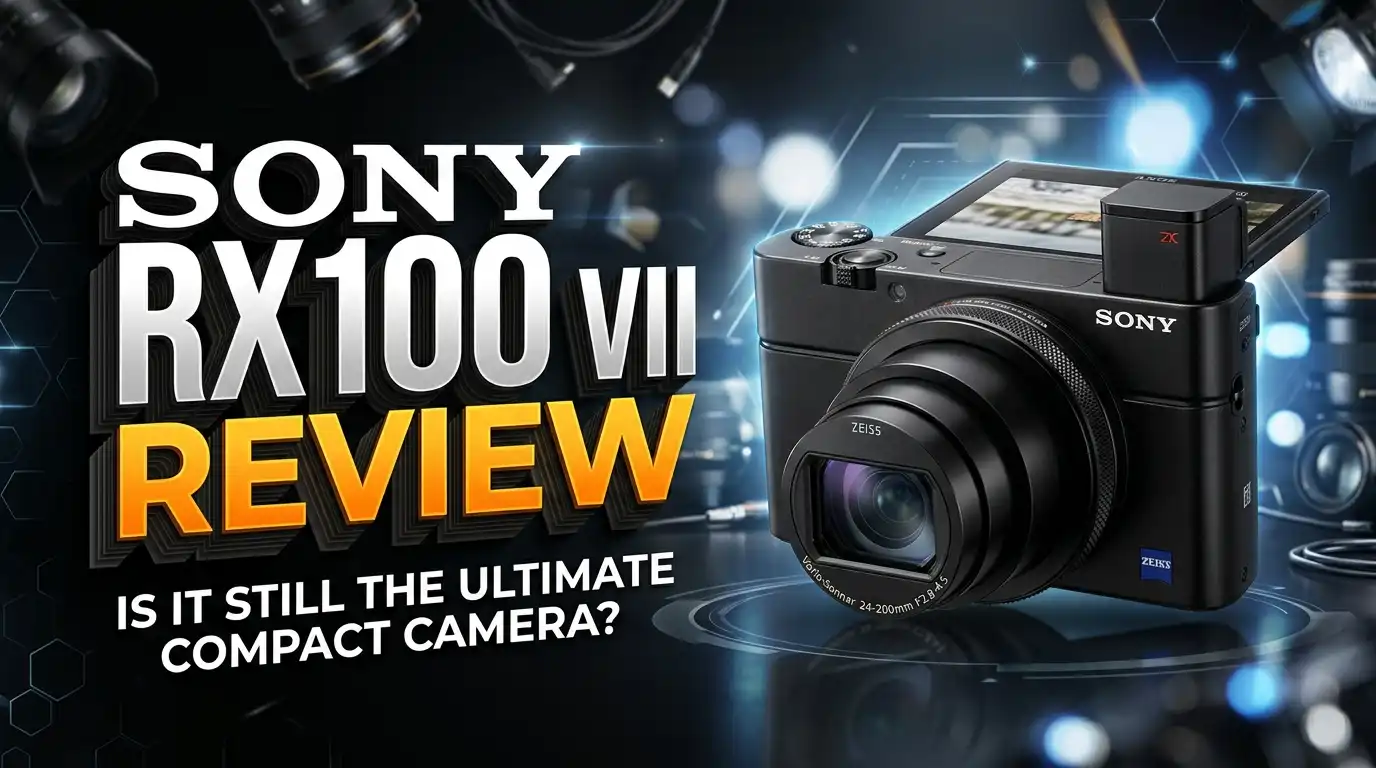
Sony RX100 VII Review 2026: Worth Your Money?
The Sony RX100 VII first launched in 2019. Seven years later, it still sits at the top of almost every “best compact camera” list. That says something powerful.
In a market flooded with smartphones boasting triple and quad cameras, this tiny Sony continues to impress photographers and travelers. But does it really hold up in 2026?
This Sony RX100 VII review puts the camera through its paces with a fresh set of eyes. We look at its 20.1MP 1-inch sensor, its blazing fast autofocus, its 4K video, and its incredibly small body.
Key Takeaways
- The Sony RX100 VII packs a 20.1MP 1-inch stacked CMOS sensor into a body that weighs just 302 grams. It produces sharp, detailed photos that outperform any smartphone.
- Its 24-200mm ZEISS zoom lens gives you an 8.3x optical zoom range. This covers everything from wide landscapes to distant wildlife shots, all from a single pocket camera.
- The autofocus system uses 357 phase-detection AF points and 425 contrast-detection AF points. It locks on in just 0.02 seconds and includes real-time eye tracking for both humans and animals.
- 4K video recording with full pixel readout makes this a strong choice for vloggers and content creators. A 3.5mm mic input adds a layer of versatility most compact cameras lack.
- Battery life remains the biggest weakness. The NP-BX1 battery is rated for about 260 shots per charge. You will likely need to carry a spare for a full day of shooting.
- The price has increased significantly in 2026, with the camera now retailing around $1,499 to $1,699 in many markets. This makes the value proposition harder to justify for casual shooters.
Sony RX100 VII Overview

- 20. 1MP 1. 0 Type stacked CMOS sensor, Zeiss Vario Sonnar T 24 200 millimeter F2. 8 F4. 5 large aperture high...
- 0. 02 sec. High AF speed, 357 point focal plane Phase detection AF and 425 point contrast detection AF
The Sony RX100 VII (model DSC-RX100M7) is a premium compact camera built for serious photography in a small form factor. Sony designed it around a 1.0-type stacked CMOS sensor with 20.1 megapixels. The “stacked” design allows for faster readout speeds and better overall performance.
This camera borrows autofocus technology from Sony’s flagship Alpha A9 mirrorless camera. That means you get real-time tracking, real-time eye AF, and incredibly fast burst shooting at up to 20 frames per second. It also records 4K video without any crop, using the full width of the sensor.
The body measures just 101.6 x 58.1 x 42.8 mm. You can slip it into a jacket pocket or a small bag with zero fuss. Despite its compact size, it features a pop-up electronic viewfinder, a tilting LCD screen, and a built-in flash.
Build Quality and Design
The RX100 VII feels premium in your hands. Sony uses a solid metal body that resists scratches and daily wear. The camera does not feel cheap or fragile at all.
The top plate houses a pop-up flash, a pop-up EVF (electronic viewfinder), a mode dial, and a shutter button with a zoom lever. The back features the 3-inch tilting touchscreen LCD that flips up 180 degrees for selfies and vlogging.
One common criticism is the lack of a grip. The flat body can feel slippery, especially in humid or rainy conditions. Sony sells an optional shooting grip (VCT-SGR1), and many users recommend it. The camera also lacks weather sealing, so you need to be careful around rain or dust.
Overall, the build quality is impressive for a camera this small. It strikes a good balance between portability and usability.
Lens Performance: 24-200mm ZEISS Zoom
The ZEISS Vario-Sonnar T 24-200mm f/2.8-4.5 lens* is one of the biggest selling points of the RX100 VII. This 8.3x optical zoom covers a huge range of focal lengths. You go from wide-angle landscapes at 24mm to tight telephoto shots at 200mm.
The lens uses 15 elements in 12 groups, including four aspherical elements and two ED (extra-low dispersion) elements. This design minimizes chromatic aberration and distortion. The T* coating also reduces flare and ghosting.
At the wide end (f/2.8), the lens performs very well in low light. As you zoom in, the maximum aperture drops to f/4.5 at 200mm. This is expected for a compact zoom but does limit low-light telephoto shots.
Sharpness across the zoom range is excellent for a 1-inch sensor camera. Center sharpness is particularly strong, while edges soften slightly at the extreme telephoto end.
Top 3 Alternatives for Sony RX100 VII
1. Ricoh GR IIIx offers a larger APS-C sensor in an even more compact body. It has a fixed 40mm equivalent lens and produces stunning image quality. It lacks a zoom lens but excels at street photography and everyday shooting.

- [GR with a 40mm angle of view] A focal length of 40mm provides a highly versatile angle of view that is close to the...
- [The ultimate snapshot camera] GR unchanging concept: High image quality, Quick response, Portability, and Evolving
2. Canon PowerShot G7X Mark III is the closest direct competitor. It has a 1-inch sensor, a 24-100mm lens, and excellent video features including livestreaming. It costs less than the RX100 VII and delivers solid results.

- 20. 1 Megapixel 1. 0” stacked CMOS sensor and DIGIC 8 Image processor.
- 4. 2x optical zoom Lens (24-100mm f/1. 8-2. 8) with optical image Stabilizer.
3. Fujifilm X100VI is a premium compact with a 40.2MP APS-C sensor, in-body stabilization, and Fujifilm’s famous film simulation modes. It uses a fixed 23mm (35mm equivalent) lens. It costs more but delivers outstanding image quality.

- 40.2MP X-Trans CMOS 5 HR Sensor
- Up to 6.0 stops In-Body Image Stabilization
Autofocus System: Speed and Accuracy
The autofocus on the RX100 VII is borrowed from the Sony Alpha A9, one of the fastest professional cameras ever made. This compact camera features 357 focal-plane phase-detection AF points that cover 68% of the frame. An additional 425 contrast-detection AF points support the system.
The camera achieves an AF acquisition time of just 0.02 seconds. That is remarkably fast for any camera, let alone a compact. It can also perform 60 AF/AE calculations per second during burst shooting.
Real-time tracking uses AI-based subject recognition to follow moving objects. Real-time eye AF works for both humans and animals, making it great for portraits and pet photography. The system is sticky and reliable. Once it locks onto a subject, it holds focus with impressive consistency.
For a pocket camera, this AF system is frankly overkill in the best possible way.
Image Quality in 2026
The 20.1MP 1-inch stacked CMOS sensor (Exmor RS) produces clean, detailed images. Photos look sharp at normal viewing sizes and hold up well for prints up to about 16×20 inches.
The dynamic range is good for a 1-inch sensor, though it cannot match APS-C or full-frame cameras. Shooting in RAW gives you much more flexibility in post-processing compared to JPEG only. Highlights and shadows recover well in editing software like Lightroom.
Low-light performance is respectable. ISO 100 to 800 produces clean results. ISO 1600 shows some noise but remains very usable. Beyond ISO 3200, noise becomes more visible, and fine detail starts to soften.
In 2026, smartphone cameras have improved dramatically. But the RX100 VII still beats them in overall detail, color accuracy, bokeh, and especially telephoto reach. The 1-inch sensor captures noticeably more light than any phone sensor.
4K Video Recording and Vlogging
The RX100 VII records 4K (3840×2160) video at 30fps with full pixel readout and no pixel binning. This produces clean, detailed footage with minimal moiré. It also supports 1080p at up to 120fps for smooth slow-motion clips.
Sony added a 3.5mm microphone input on the RX100 VII, a first for the series. This makes a huge difference for vloggers and content creators who want better audio quality. The built-in microphone is decent for casual use, but an external mic dramatically improves results.
The 180-degree tilting screen lets you see yourself while filming. Active SteadyShot stabilization keeps handheld footage smooth, though a gimbal still helps for walking shots.
One limitation is the recording time. The camera can overheat during extended 4K sessions, especially in warm environments. Most users report about 15-20 minutes of continuous 4K before the camera needs a rest.
Electronic Viewfinder and LCD Screen
The pop-up electronic viewfinder (EVF) is a standout feature. It uses a 2.36 million dot OLED panel with ZEISS T* coating. The image is bright, sharp, and easy to compose with, even in direct sunlight where LCD screens wash out.
The EVF pops up manually with a switch on the side. You then pull the eyepiece back to activate it. This mechanism feels a bit delicate, and some long-term users report that it can loosen over time.
The 3.0-inch tilting touchscreen LCD has approximately 921,600 dots. It tilts up 180 degrees and down about 90 degrees. Touch focus and touch shutter functions work smoothly. The screen is bright and color-accurate enough for quick shot reviews.
You cannot use both the EVF and LCD at the same time. A sensor near the EVF automatically switches between the two when you bring the camera to your eye.
Battery Life: The Biggest Weakness
Battery life is the most frequent complaint about the Sony RX100 VII. The camera uses the NP-BX1 lithium-ion battery, a small cell that Sony has used across the RX100 series since the original model.
Sony rates the RX100 VII for approximately 260 shots per charge using the LCD screen. With the EVF, that number drops to about 240. Real-world usage often falls below these numbers, especially if you use burst mode, 4K video, or Wi-Fi frequently.
For 4K video recording, users report roughly 40-45 minutes of total record time before the battery dies. This is a serious limitation for anyone who films longer events or travel vlogs.
The good news is that spare NP-BX1 batteries are affordable and widely available. The camera also charges via USB, so a power bank can top it off between shooting sessions. Carrying two or three spare batteries is the standard advice from most RX100 VII owners.
Connectivity and Wireless Features
The RX100 VII includes Wi-Fi, Bluetooth, and NFC for wireless connectivity. You can transfer photos to your smartphone using the Sony Imaging Edge Mobile app (now updated and renamed in some regions).
Bluetooth provides a low-power connection for location data tagging. Wi-Fi handles faster photo transfers and remote control shooting. NFC allows one-touch pairing with compatible Android devices.
The camera also has a Micro HDMI output for connecting to external monitors or recorders. The Micro USB port handles charging and data transfer. There is no USB-C port, which feels outdated in 2026.
Remote shooting via the app works but can be laggy at times. The connection is stable enough for basic remote triggering and photo review. It is not ideal for professional tethered shooting, though.
Sony RX100 VII for Travel Photography
This is where the RX100 VII truly shines. Its compact size, long zoom range, and fast autofocus make it one of the best travel cameras you can buy. You get a 24-200mm lens in a body that fits in your front pocket.
The wide-angle 24mm end captures architecture, landscapes, and group photos with ease. The 200mm telephoto end lets you zoom into distant subjects like wildlife, street scenes, or landmarks. No lens changes. No heavy backpack. Just one small camera that does it all.
Real-time tracking and eye AF handle fast-moving subjects like children, street performers, or animals at a zoo. Burst shooting at 20fps ensures you capture the perfect moment.
Many travel photographers use the RX100 VII as their only camera. Others carry it as a backup alongside a mirrorless or DSLR system. Either way, it delivers results that impress.
Who Should Buy the Sony RX100 VII in 2026?
The RX100 VII suits a specific type of buyer. It is perfect for travelers who want excellent photos without carrying heavy gear. It is great for vloggers who need 4K video with a mic input in a small package.
It also works well as a secondary camera for professional photographers. If you shoot weddings or events with a full-frame system, the RX100 VII fits in your pocket as a discreet backup.
Casual photographers who only take occasional snapshots may find the price too steep. A modern smartphone or a more affordable compact camera might serve them better. The RX100 VII is a premium product with a premium price tag.
If you value portability above all else and want the best image quality possible from a pocket camera, the RX100 VII remains a strong choice. No other compact camera in 2026 offers this combination of zoom range, autofocus speed, and video quality in such a small body.
Pricing and Value in 2026
The Sony RX100 VII originally launched at $1,199 MSRP in 2019. In 2026, the price has increased to approximately $1,499 to $1,699 depending on the retailer and region. Some markets have seen price hikes of over 30% due to supply constraints and tariffs.
This is a lot of money for a compact camera. The rising price makes it harder to recommend for casual users. However, for those who need its specific feature set, there is still nothing quite like it on the market.
Used and refurbished units can be found for less, often around $800 to $1,000. This represents much better value if you are comfortable buying secondhand. Check reputable sellers on Amazon, B&H Photo, or KEH Camera for certified pre-owned options.
Sony has not announced an RX100 VIII as of early 2026. The mark VII remains the latest and final model in the series, which adds to its collectibility and resale value.
Pros and Cons Summary
The pros of the Sony RX100 VII include its outstanding autofocus system, versatile 24-200mm zoom, excellent 4K video with mic input, pop-up EVF, compact pocketable size, and strong image quality from the 1-inch sensor.
The cons include poor battery life, rising prices, no USB-C, no weather sealing, a slippery body without a grip, and potential overheating during long 4K recordings. The 1-inch sensor also cannot match larger-sensor cameras in low light or dynamic range.
For the right user, the pros far outweigh the cons. The RX100 VII does more in a smaller package than any other compact camera available today. If its limitations align with your expectations, you will love this camera.
Final Verdict: Sony RX100 VII in 2026
- 20. 1MP 1. 0 Type stacked CMOS sensor, Zeiss Vario Sonnar T 24 200 millimeter F2. 8 F4. 5 large aperture high...
- 0. 02 sec. High AF speed, 357 point focal plane Phase detection AF and 425 point contrast detection AF
The Sony RX100 VII remains one of the best compact cameras money can buy in 2026. Its combination of a long zoom lens, lightning-fast autofocus, reliable image quality, and pocketable design is still unmatched. No other camera packs this much capability into such a small body.
The main concern is the price. At $1,500 or more, you need to be sure this camera fits your specific needs. If you are a frequent traveler, a street photographer, or a content creator who values portability, the RX100 VII delivers outstanding results every time you pick it up.
It is seven years old, and it still competes. That is the ultimate endorsement.
Frequently Asked Questions
Is the Sony RX100 VII still worth buying in 2026?
Yes, the Sony RX100 VII remains the best compact zoom camera you can buy. Its 24-200mm lens, fast autofocus, and 4K video make it extremely capable. The main drawback is its high price, which has increased since launch. If you need a pocketable camera with zoom, it is still the top choice.
How does the RX100 VII compare to a smartphone camera?
The RX100 VII outperforms smartphones in several key areas. Its 1-inch sensor captures more light and detail. The optical 8.3x zoom produces much sharper telephoto images than any phone’s digital zoom. It also offers RAW shooting, manual controls, and a real pop-up viewfinder.
What is the battery life of the Sony RX100 VII?
Sony rates the battery at approximately 260 shots per charge. Real-world usage is often lower, especially with heavy video recording or burst shooting. Most users carry one or two spare NP-BX1 batteries for a full day of shooting.
Can the Sony RX100 VII shoot 4K video?
Yes, it records 4K at 30fps with full pixel readout. It also supports 1080p at 120fps for slow motion. A 3.5mm mic input allows you to connect an external microphone for better audio quality.
Is there a Sony RX100 VIII coming?
As of March 2026, Sony has not announced an RX100 VIII. The mark VII remains the current and possibly final model in the RX100 series. This has contributed to its increasing resale value and scarcity in some markets.
Does the Sony RX100 VII have image stabilization?
Yes, it features optical image stabilization (Optical SteadyShot) for photos. For video, it offers Active SteadyShot and Intelligent Active mode for enhanced stabilization. These systems reduce blur from hand shake during both photos and video recording.

Hi, I’m Emma! I’m that friend who always gets asked “Should I buy this gadget?” – and I love it. After years of being the unofficial tech advisor for family, friends, and coworkers, I realized I had a knack for cutting through marketing hype to find what actually works.
Last update on 2026-03-17 / Affiliate links / Images from Amazon Product Advertising API