Canon SX740 HS Review 2026: Worth The Hype?
The Canon PowerShot SX740 HS first hit the market back in 2018. Yet here we are in 2026, and this little camera still flies off shelves. Why?
Because no other pocket camera packs a 40x optical zoom into such a small body. Smartphones have gotten smarter, but they still can’t match real optical zoom at this range.
But is it the right camera for you in 2026? Are newer alternatives better? This full review breaks down every detail. We cover image quality, zoom performance, battery life, video features, and real-world usability.
Key Takeaways
- The Canon SX740 HS offers a 40x optical zoom (24mm to 960mm equivalent), which is one of the longest zoom ranges available in a camera this small.
- It records 4K UHD video at 30fps, a feature that was a major upgrade over its predecessor, the SX730 HS. The footage looks sharp and detailed in good light.
- The 20.3MP CMOS sensor paired with the DIGIC 8 processor delivers clean images in daylight.
- The flip-up LCD screen tilts 180 degrees, which makes it perfect for selfies and vlogging. There is no electronic viewfinder, so you rely entirely on the 3-inch screen.
- Battery life sits at about 265 shots per charge (370 in Eco Mode), which is average for this category. Carrying a spare battery on long trips is a smart idea.
- This camera still sells at a premium despite its age, largely due to limited supply and high demand. Compare it with newer alternatives like the Panasonic LUMIX ZS99 before you decide.
Canon PowerShot SX740 HS Overview

- 40x optical zoom with optical image stabilizer and zoom framing assist
- 4K video and 4K time-lapse movie
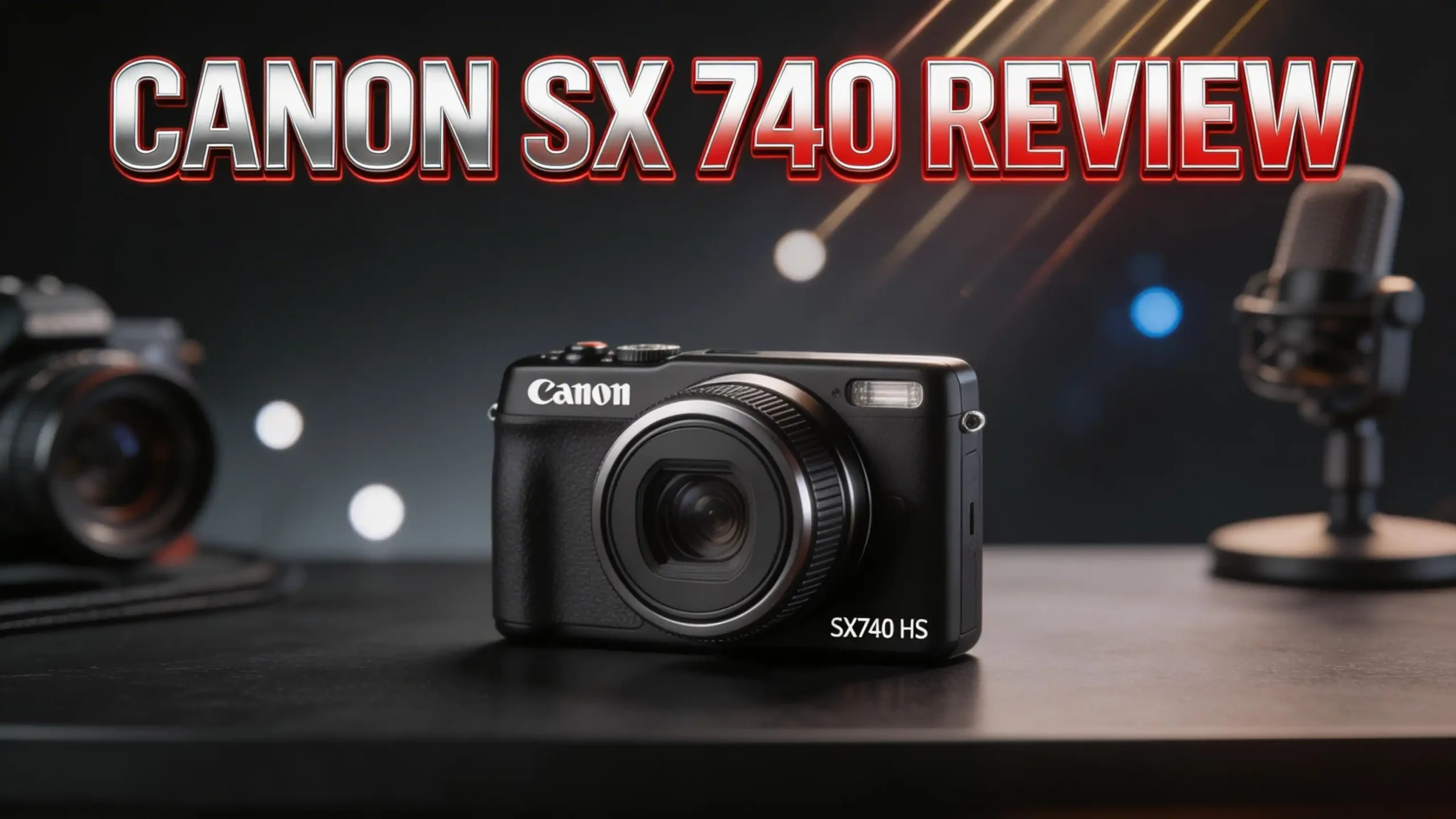
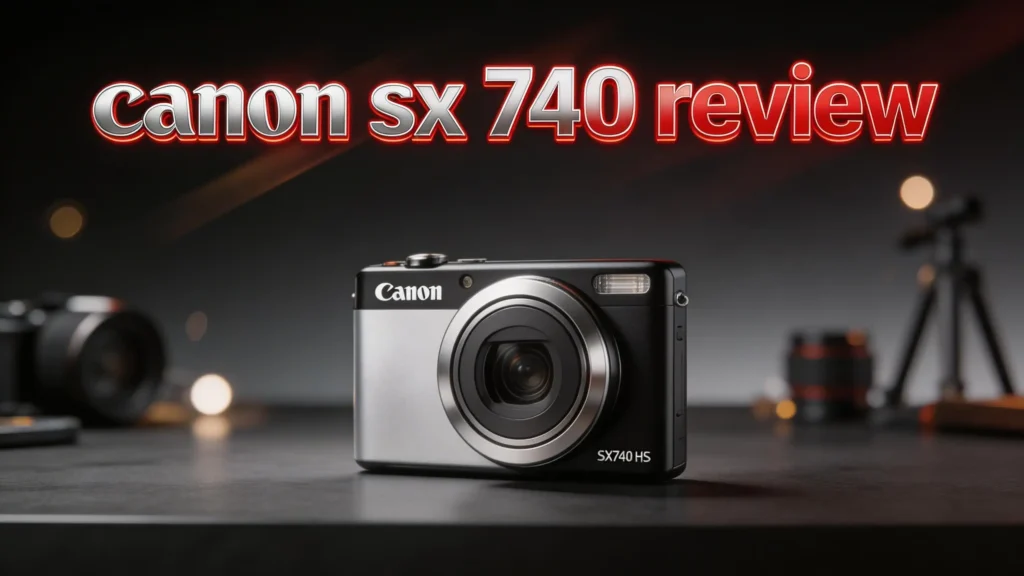
The Canon PowerShot SX740 HS is a compact superzoom camera built for people who want impressive reach without carrying a big camera bag. Canon designed it around a 20.3-megapixel 1/2.3-inch CMOS sensor and a powerful 40x optical zoom lens.
This lens covers a focal range equivalent to 24mm to 960mm in 35mm terms. That range lets you shoot wide landscapes and then zoom in on a bird across a lake. The DIGIC 8 image processor handles everything from autofocus to noise reduction.
The body weighs just 299 grams with the battery and memory card. It fits easily in a jacket pocket or a small purse. Canon offers it in both black and silver finishes. Even in 2026, this camera holds a loyal following among travelers, hobbyists, and casual photographers who value simplicity and zoom power above all else.
Design and Build Quality
The SX740 HS has a clean, rectangular body with rounded edges. It feels solid in hand despite its lightweight plastic construction. The grip on the front is minimal, so you may want to use the wrist strap Canon includes in the box.
All the essential buttons sit on the right side and the top plate. You get a dedicated mode dial, shutter button, zoom lever, and a video record button. The layout is intuitive. Even first-time camera users will figure it out quickly.
The bottom houses the battery and SD card compartment under a single door. The USB port uses a Micro USB connection, which feels dated in 2026.
Canon did not include USB-C on this model. Still, the overall build feels reliable for everyday use, and the compact size remains one of its strongest selling points.
Zoom Performance and Lens Quality
The 40x optical zoom is the headline feature of this camera. It starts at a wide 24mm and extends all the way to 960mm equivalent.
Very few pocket cameras match this range. Canon also offers ZoomPlus, which doubles the reach digitally to 80x with minimal quality loss.
In practice, the zoom works smoothly. The lever on top of the camera provides variable speed control. A gentle push zooms slowly for video. A firm push zooms quickly for stills. Canon’s Zoom Framing Assist feature helps you re-locate subjects if you lose them at full zoom.
Image quality at the wide end is sharp and detailed. At full zoom, sharpness drops slightly, and you may notice some softness at the edges. Optical Image Stabilization helps reduce shake at long focal lengths. Overall, the zoom performance is excellent for this class of camera.
Top 3 Alternatives for Canon PowerShot SX740 HS
1. Panasonic LUMIX ZS99

- The Powerhouse Pocket Camera You've Been Looking For: 24-720mm LEICA lens with 30x Zoom and a compact body that slips in...
- 4K Video and Photo for Bright, Sharp Images: Relive your favorite moments in high-quality 4K video at 30p or capture...
The ZS99 launched in early 2025 and is Panasonic’s newest travel zoom. It features a 30x zoom lens (24-720mm), 20.3MP sensor, and 5-axis Hybrid O.I.S.+ stabilization. It also adds modern features like USB-C charging and improved autofocus.
2. Sony Cyber-shot DSC-HX99

- ZEISS Vario-Sonnar T* 24-720mm High Magnification Zoom and High Image Quality Lens
- Stunning 4K video with full pixel readout and no pixel binning
The Sony HX99 packs a 30x zoom (24-720mm) into the world’s smallest body at this zoom range. It includes an electronic viewfinder, a touchscreen, and 4K video. It is a strong option if you prefer a tiny camera with a viewfinder.
3. Panasonic LUMIX ZS80D

- Large sensor: 1/2.3 Inch 20. 3MP MOS high resolution sensor provides improved low light performance by significantly...
- Leica DC VARIO ELMAR lens: features an impressively sharp 24mm ultra wide Angle 30x telephoto lens (35mm camera...
The ZS80D offers a 30x Leica zoom lens, electronic viewfinder, and 4K video. It sits between the older ZS80 and the newer ZS99 in terms of features. It is a good mid-range pick with solid image stabilization.
Image Quality and Sensor Performance
The SX740 HS uses a 1/2.3-inch CMOS sensor with 20.3 megapixels. This sensor size is standard for compact superzooms. It captures plenty of detail in bright daylight. Colors look vibrant and accurate straight out of the camera.
Canon’s DIGIC 8 processor helps reduce noise at higher ISO levels. Images stay clean up to about ISO 400. Beyond ISO 800, you will start to see grain and loss of fine detail. This is normal for a sensor this small.
Dynamic range is limited compared to larger-sensor cameras. Highlights can blow out in high-contrast scenes. Shadows lose detail if you try to recover them in editing. For social media sharing and standard-size prints, the image quality is more than good enough.
4K Video Capabilities
The SX740 HS records 4K UHD video at 30 frames per second. This was a big addition over the SX730 HS, which topped out at 1080p. The 4K footage looks crisp and colorful in good light.
There are a few things to know. Canon applies a 1.6x crop during 4K recording, which narrows your field of view. You lose the wide-angle perspective. Also, there is no microphone input. The built-in microphone picks up wind noise easily during outdoor shooting.
Continuous autofocus works during video, though it can hunt a bit in low contrast. You also get a 4K Time-Lapse mode, which creates short, fun clips from sequences of still frames. For casual vlogging and travel videos, the 4K capability is a nice bonus.
Autofocus System
The SX740 HS uses a contrast-detect autofocus system. It works well in bright light. The camera locks onto subjects quickly and accurately in most outdoor conditions.
In low light, autofocus slows down. You may experience some hunting as the camera searches for focus. There is no phase-detect autofocus on this model, so tracking fast-moving subjects can be a challenge.
Canon includes face detection and a self-portrait mode that recognizes your face when you flip the screen up. These features work reliably for group shots and selfies. For general travel and landscape use, the autofocus system performs well enough. Action and sports photography will push its limits.
Battery Life and Charging
Canon rates the SX740 HS at 265 shots per charge using the NB-13L battery. In Eco Mode, that number rises to about 370 shots. Video recording lasts approximately 60 minutes of continuous shooting.
These numbers are average for this camera class. A full day of heavy shooting will drain the battery. You will want a spare battery if you plan a long day of sightseeing or wildlife watching.
Charging happens via the Micro USB port, so you can top up the battery using a portable power bank. This is a convenient feature for travelers. However, charging through USB is slower than using Canon’s dedicated wall charger. The battery compartment accepts only the NB-13L, so make sure to buy Canon-compatible replacements.
Wi-Fi, Bluetooth, and Connectivity
The SX740 HS has built-in Wi-Fi and Bluetooth. You pair it with your smartphone using Canon’s Camera Connect app. Once connected, you can transfer photos wirelessly and use your phone as a remote shutter.
Bluetooth keeps a low-energy connection active at all times. When you want to transfer images, the camera switches to Wi-Fi for faster speeds. The process is straightforward once you complete the initial setup.
Image transfer speeds are decent but not blazing fast. Full-resolution photos take a few seconds each. You can also upload images directly to cloud services through your connected phone. GPS data from your phone can be added to photos for geotagging, which is useful for travel photographers who want to remember exactly where each shot was taken.
Flip-Up LCD Screen
The SX740 HS features a 3-inch LCD screen that flips up 180 degrees. This makes it ideal for selfies, group photos, and low-angle shots. You can see yourself clearly while framing the shot.
The screen resolution sits at 922,000 dots, which is sharp enough for reviewing images and composing shots. It is not a touchscreen, so all navigation happens through physical buttons and dials.
There is no electronic viewfinder (EVF) on this camera. In bright sunlight, the LCD screen can be hard to see. This is one area where competitors like the Sony HX99 and Panasonic ZS80D have an advantage. They include small EVFs for sunny-day shooting. If you mostly shoot indoors or in moderate light, the LCD screen works perfectly fine.
Shooting Modes and Creative Features
The SX740 HS gives you full manual control with PASM modes. You can set aperture, shutter speed, and ISO independently. This is a welcome feature for users who want creative control beyond full auto.
Canon also includes Scene modes, Creative Filters, and a dedicated Food mode. The camera can shoot at up to 10 frames per second in continuous burst mode, which drops to 7.4 fps with continuous autofocus.
Self-portrait mode activates automatically when you flip the screen up. It smooths skin tones and adjusts exposure for flattering results. RAW shooting is not available on the SX740 HS. All images save as JPEG only. This limits how much you can edit photos after the fact, but it keeps file sizes manageable and workflow simple.
Who Should Buy the Canon SX740 HS in 2026?
This camera suits a specific type of user. Travelers who want big zoom in a small package will love it. Parents capturing school events and sports days will appreciate the reach. Birdwatchers and nature lovers will enjoy the 40x zoom for distant subjects.
It is also a solid pick for social media creators who want better photos than a smartphone can deliver. The flip-up screen helps with selfies and vlogging. The 4K video is a bonus for short-form content.
However, if you need excellent low-light performance, a larger sensor camera is a better choice. If you want RAW files for advanced editing, look elsewhere. And if you shoot fast action regularly, the contrast-detect autofocus may frustrate you. Know your priorities before you buy.
Canon SX740 HS vs. Panasonic LUMIX ZS99
The Panasonic LUMIX ZS99 is the SX740’s most direct competitor in 2026. It launched in 2025 with updated technology. The ZS99 offers a 30x zoom versus the SX740’s 40x. So Canon wins on raw zoom reach.
The ZS99 includes 5-axis Hybrid O.I.S.+, USB-C charging, and improved autofocus. It also has a touchscreen LCD and a built-in electronic viewfinder. These are meaningful upgrades over the Canon.
Image quality is similar between the two cameras, since both use 1/2.3-inch sensors with 20.3MP resolution. The ZS99 has better video stabilization and modern connectivity. The SX740 HS has a longer zoom range and a proven track record. Your choice depends on whether you value zoom reach or modern features more.
Pricing and Value in 2026
- 40x optical zoom with optical image stabilizer and zoom framing assist
- 4K video and 4K time-lapse movie
The Canon SX740 HS originally retailed for around $399. In 2026, prices have increased due to limited stock and high demand. You may find new units priced between $400 and $550 depending on the seller and included accessories.
Refurbished and renewed models offer some savings. Check Amazon and Best Buy for bundle deals that include memory cards, cases, and extra batteries. These bundles often provide better value than buying accessories separately.
Considering the camera is now several years old, the elevated pricing is worth questioning. Newer alternatives offer updated features at similar or slightly higher price points. If you find the SX740 HS at or near its original retail price, it remains a strong value. At inflated prices, compare it carefully with the Panasonic ZS99 or Sony HX99.
Pros and Cons Summary
The SX740 HS has clear strengths. Its 40x zoom is unmatched in a camera this small. The 4K video, flip-up screen, and simple controls make it approachable for all skill levels. Wireless connectivity and USB charging add travel-friendly convenience.
On the downside, the lack of an electronic viewfinder is a real drawback. Battery life is average. The Micro USB port feels outdated. Low-light performance is modest due to the small sensor. No RAW shooting limits post-processing flexibility.
These trade-offs are typical for compact superzooms. No pocket camera does everything perfectly. The SX740 HS does zoom and portability better than almost anything else on the market. If those are your top priorities, the cons are easy to accept.
Final Verdict
The Canon PowerShot SX740 HS has stood the test of time. In 2026, it remains one of the best compact superzoom cameras you can buy. Its 40x optical zoom in a pocket-sized body is a winning formula that few competitors can match.
The camera is ideal for travel, casual photography, and anyone who wants better reach than a smartphone. It delivers good image quality in daylight, smooth 4K video, and a user-friendly experience.
Should you buy it? Yes, if zoom range and portability are your top priorities. If you need modern features like USB-C, a viewfinder, and a touchscreen, consider the Panasonic LUMIX ZS99 instead. Either way, the SX740 HS has earned its reputation as a dependable travel companion.
Frequently Asked Questions
Is the Canon SX740 HS still a good camera in 2026?
Yes. The Canon SX740 HS still performs well for travel and casual photography. Its 40x zoom, 4K video, and compact design hold up against newer models. Image quality in good light remains impressive. It is best for daytime shooting and outdoor use.
Does the Canon SX740 HS have a viewfinder?
No. The SX740 HS does not include an electronic viewfinder. You compose all shots using the 3-inch flip-up LCD screen. This can be difficult in bright sunlight. Alternatives like the Sony HX99 and Panasonic ZS80D include small EVFs.
Can the Canon SX740 HS shoot in RAW format?
No. The SX740 HS saves images in JPEG format only. It does not support RAW files. This limits editing flexibility in post-processing software. If RAW capture is important to you, consider a different camera.
How far can the Canon SX740 HS zoom?
The camera has a 40x optical zoom with a focal length range of 24mm to 960mm (35mm equivalent). With ZoomPlus, it extends digitally to 80x. This makes it one of the longest-reaching pocket cameras available.
What memory card does the Canon SX740 HS use?
The SX740 HS accepts SD, SDHC, and SDXC memory cards. For 4K video recording, Canon recommends using a UHS Speed Class 3 (U3) card or faster. A 64GB card gives you plenty of room for photos and video clips.
Is the Canon SX740 HS good for vlogging?
It works for basic vlogging. The flip-up screen lets you see yourself while recording. The 4K video is a plus. However, there is no external microphone input, and the built-in mic picks up wind noise. Serious vloggers may want a camera with better audio options.

Hi, I’m Emma! I’m that friend who always gets asked “Should I buy this gadget?” – and I love it. After years of being the unofficial tech advisor for family, friends, and coworkers, I realized I had a knack for cutting through marketing hype to find what actually works.
Last update on 2026-03-19 / Affiliate links / Images from Amazon Product Advertising API