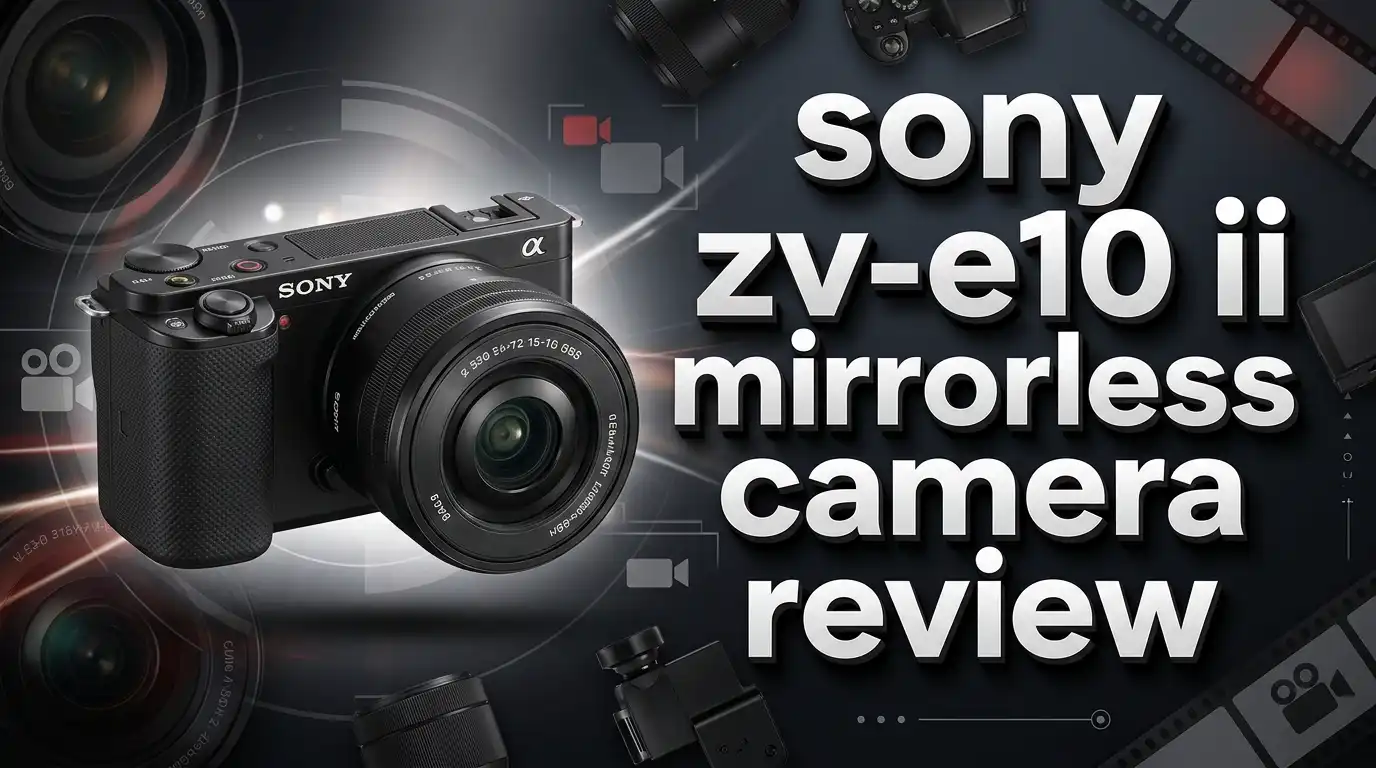
Sony ZV-E10 II Mirrorless Camera Review 2026: Worth Every Penny?
Sony made waves with the original ZV-E10. Content creators loved it. But it had clear limits. The Sony ZV-E10 II arrived as a long-awaited sequel, and it brings serious upgrades to the table.
A new 26MP sensor, 10-bit video capture, and a much bigger battery transform this compact camera into a proper creative tool.
In this review, we break down everything about the Sony ZV-E10 II. We cover video quality, image performance, autofocus, battery life, handling, and much more.
We also compare it to the competition so you can decide if this is the right camera for your needs. Read on to find out if this is the vlogging camera you have been waiting for.
Key Takeaways
- The 26MP APS-C BSI CMOS sensor is the same one found in the Sony a6700 and FX-30. It delivers sharp, vibrant images and oversampled 4K video with excellent detail and color accuracy.
- 10-bit video recording is a major upgrade over the 8-bit capture of the original ZV-E10. This gives content creators much more flexibility during color grading, especially when shooting in S-Log3.
- 4K recording at up to 60fps is now possible with just a 1.1x crop. The original model struggled with a heavy crop even at 4K/30p. Rolling shutter is also dramatically reduced thanks to the faster sensor readout.
- The NP-FZ100 battery replaces the smaller NP-FW50 from the original. This pushes continuous video recording up to 195 minutes per charge, a massive improvement that solves one of the biggest complaints about the first generation.
- The body retails at $999 and the kit with the 16-50mm lens at $1,099. This is a $300 increase over the original ZV-E10 kit price. The jump is significant, but the upgrades in sensor, processor, battery, and video quality justify the cost for serious creators.
- No in-body image stabilization (IBIS) and no mechanical shutter remain notable omissions. If you need IBIS or plan to shoot fast action stills with flash, the Sony a6700 is a better fit despite its higher price.
Sony ZV-E10 II Mirrorless Camera Overview

- Exmor R CMOS sensor: The ZV-E10 II features Sony's most advanced sensor technology in an APS-C back-illuminated Exmor R...
- Interchangeable lenses to capture your vision : From the G Master series, which blends breathtaking resolution with...

Last update on 2026-09-11 / Affiliate links / Images from Amazon Product Advertising API
The Sony ZV-E10 II is a second-generation APS-C mirrorless camera built specifically for content creators. Sony released it as a direct upgrade to the popular original ZV-E10. The camera uses the Sony E-mount system, giving users access to a huge library of lenses.
At just 377 grams, the ZV-E10 II is impressively light. It measures 121 x 68 x 54mm, making it easy to carry in a small bag or even a jacket pocket with the right lens. The body comes in black or white.
Sony equipped the camera with a fully articulating 3.0-inch touchscreen LCD with 1.04 million dots. The screen rotates to face forward, which is essential for solo vlogging.
The interface even rotates automatically when you turn the camera for vertical video. This is a first for Sony cameras and a genuinely useful feature for TikTok and Instagram Reels creators.
There is no electronic viewfinder (EVF). This is a deliberate choice by Sony to keep the body slim and the price down. For vlogging, you rarely need a viewfinder. But for photography in bright sunlight, this can be a drawback.
Design and Build Quality
The ZV-E10 II looks similar to early Sony NEX models. It has a clean, minimal design with a small but functional grip on the front. The body feels solid in hand, though the plastic construction keeps the weight low.
On the top plate, you will find a single control dial, a record button, a shutter button with zoom rocker, and the still/movie/S&Q mode switch. This three-way switch is a nice upgrade from the original model’s button-based switching system.
Sony also included two customizable buttons on the body. One defaults to the Background Defocus (Bokeh) function, and the other activates Product Showcase mode. Product Showcase tells the camera to prioritize nearby objects over detected faces. This is perfect for unboxing videos and product reviews.
The port selection is solid. You get a 3.5mm mic input, a 3.5mm headphone jack, a USB-C port (5Gbps), and a micro HDMI output. The USB-C port supports webcam streaming at up to 4K/30p. A UHS-II compatible SD card slot sits on the side of the body.
Video Performance and Quality
Video quality is where the Sony ZV-E10 II truly shines. The camera records oversampled 4K video from a 6K capture at frame rates up to 30p. At 4K/60p, it captures from 5.6K with just a 1.1x crop. This is a huge improvement over the original.
The camera supports 10-bit recording in both H.264 and H.265 codecs. You can choose between Long-GOP and All-I compression types. H.265 gives you a good balance of quality and file size. H.264 produces larger files but is easier to edit on older computers.
S-Log3 and S-Cinetone color profiles are both available. S-Log3 gives maximum dynamic range for color grading. S-Cinetone provides a pleasing, film-like look straight out of the camera. You can also import custom LUTs for previewing, embedding, or applying to your footage.
The CineVlog mode adds a 2.35:1 widescreen look with black bars and shoots at 24p. Various “Looks” and “Moods” can be layered on top. This is great for creators who want a cinematic feel without post-production work.
Full HD recording goes up to 120fps for smooth slow-motion footage. This is useful for creative B-roll and transitions.
Autofocus System
The Sony ZV-E10 II uses a 759-point hybrid phase-detection autofocus system. It locks onto subjects quickly and tracks them smoothly across the frame. Face detection and eye autofocus work reliably in both stills and video modes.
Subject recognition covers humans, animals, birds, and more. The camera does not include Sony’s dedicated AI processing unit found in the a6700. But the latest recognition algorithms still deliver impressive tracking performance.
Focus breathing compensation is a standout feature. With compatible Sony lenses, the camera adjusts its crop to maintain consistent framing as the focus distance changes. This prevents the distracting “zooming” effect that often happens during focus pulls in video.
For vloggers, the autofocus is practically flawless. Point the camera at your face, and it locks on and stays locked. The Product Showcase mode smoothly transitions focus from your face to a held-up product and back again. This works without any manual intervention.
Top 3 Alternatives for Sony ZV-E10 II
1. Sony a6700 – This is Sony’s enthusiast APS-C camera with the same 26MP sensor. It adds IBIS, a viewfinder, a mechanical shutter, and 4K/120p recording. It costs more at $1,399 body-only, but it is a better all-around camera for both stills and video.

- 26.0MP APS-C format Exmor R back-illuminated CMOS sensor
- BIONZ XR processing power for exceptional image quality
Last update on 2026-10-25 / Affiliate links / Images from Amazon Product Advertising API
2. Fujifilm X-M5 – A compact and lightweight APS-C mirrorless camera with a 26.1MP X-Trans sensor. It offers beautiful Fujifilm color science, film simulation modes, and 6.2K video recording. It is a strong choice for creators who value aesthetic output.

- SUPERB IMAGE QUALITY - Featuring a 26.1MP APS-C X-Trans CMOS 4 sensor, the X-M5 captures stunningly detailed and vibrant...
- EXCELLENT LOW LIGHT - Experience exceptional low-light performance with ISO sensitivity up to 51200, allowing you to...
Last update on 2026-10-25 / Affiliate links / Images from Amazon Product Advertising API
3. Canon EOS R50 – An affordable entry-level mirrorless camera with a 24.2MP APS-C sensor and 4K/30p video. It features Canon’s Dual Pixel CMOS AF II system. It costs significantly less than the ZV-E10 II, making it a great budget-friendly option.

- High Image Quality: Canon EOS R50 4K digital camera features a 24.2 Megapixel CMOS (APS-C) sensor and DIGIC X processor...
- High-Speed Continuous Shooting: Capture fast action with up to 12 fps with Electronic First Curtain shutter and up tp...
Last update on 2026-10-25 / Affiliate links / Images from Amazon Product Advertising API
Battery Life and Power Management
Battery life was a major weakness of the original ZV-E10. Sony fixed this with the NP-FZ100 battery in the ZV-E10 II. This is the same large-capacity battery used in full-frame Sony cameras like the A7 series.
The CIPA-rated numbers are impressive. You get up to 610 shots per charge for stills. For continuous video recording, the camera lasts up to 195 minutes. The more realistic “actual” CIPA video test, which includes start/stop recording and zooming, gives you about 130 minutes.
USB Power Delivery (PD) charging is supported through the USB-C port. You can charge the battery quickly or even power the camera during long recording sessions using an external power bank. This is a critical feature for extended shoots.
In real-world use, most creators report getting well over an hour of 4K recording before needing a recharge. The old ZV-E10 often died after 45 minutes under similar conditions. This upgrade alone makes the ZV-E10 II a much more practical daily camera.
Image Stabilization
The Sony ZV-E10 II does not have in-body image stabilization (IBIS). This is one of its most notable compromises. Sony kept IBIS out to maintain the compact body size and lower price point.
Instead, the camera relies on electronic image stabilization (EIS) and optical stabilization in compatible lenses. The digital stabilization applies a 1.33x crop to the image. When combined with the 16-50mm kit lens at its widest setting, you end up with a 32mm equivalent field of view.
The electronic stabilization is much improved over the original ZV-E10. Walking footage looks smoother, and minor hand movements are well corrected. But it cannot match the performance of IBIS found in cameras like the Sony a6700.
For static vlogging at a desk or on a tripod, the lack of IBIS is a non-issue. For active, handheld run-and-gun shooting outdoors, you may want to consider the a6700 or use a gimbal. The optional Sony GP-VPT2BT shooting grip also helps stabilize handheld shooting significantly.
Still Photography Performance
The ZV-E10 II shares its 26MP sensor with the Sony a6700. This means it can capture detailed, vibrant still images with excellent dynamic range. RAW files offer plenty of room for editing shadows and highlights.
However, this camera is not designed as a stills-first device. There is no mechanical shutter. The electronic-only shutter means you may see rolling shutter distortion with fast-moving subjects. Flash photography options are also limited because of this.
The single top-plate dial makes manual exposure adjustments slower than on the a6700. The touchscreen interface works for changing settings, but it adds clutter to the display when you are trying to compose a photo.
Lossless compressed RAW is now supported, giving you slightly more editing flexibility than the lossy compressed RAW option. JPEG output is punchy and pleasant with accurate skin tones and vivid colors. For casual photography and social media posts, the image quality is more than sufficient.
Rolling Shutter and Sensor Readout
Rolling shutter was a significant problem on the original ZV-E10. The ZV-E10 II fixes this with a much faster sensor readout. In 4K/24p mode, the readout is approximately 17 milliseconds. At 4K/60p, it drops to about 16ms.
In Full HD at 24p, the readout speed is just 7 milliseconds. This is fast enough to handle most shooting situations without visible distortion.
You will still notice some rolling shutter in extreme cases. A large vehicle speeding past the camera at close range will show some warping. But for everyday vlogging, walking shots, and general content creation, rolling shutter is no longer a concern.
This improvement is directly linked to the new BSI CMOS sensor. It reads data much faster than the front-illuminated sensor in the original ZV-E10. The result is cleaner footage with fewer artifacts during motion.
Overheating: What You Need to Know
Overheating has been a talking point for the ZV-E10 II since launch. With the default settings, the camera may shut down after just 5 minutes of 4K recording at 25°C (77°F) ambient temperature. This sounds alarming, but there is a simple fix.
Setting the “Auto Power OFF Temp” to “High” in the menu dramatically extends recording times. In indoor tests at 23°C, the camera recorded 4K/60p at maximum quality (200Mbps, 10-bit, 4:2:2) for 1 hour and 17 minutes before overheating. At lower quality settings, it lasted almost 2 hours.
Outdoor shooting in direct sunlight will reduce these times. Hot summer days can be challenging for extended 4K sessions. If you shoot mostly indoors or in moderate climates, overheating should not be a major concern.
The key takeaway is simple. Change the Auto Power OFF Temp setting to High immediately after buying this camera. The default setting is overly conservative and does not reflect the camera’s true recording capability.
Audio Capabilities
The Sony ZV-E10 II features a three-capsule microphone built into the top of the body. This mic system offers an automatic directional mode that focuses audio pickup based on the camera’s orientation.
Audio quality from the built-in mic is surprisingly good for a camera this size. The included wind screen (deadcat) is a thoughtful addition. It clips onto the top and helps reduce wind noise during outdoor shoots.
For professional audio, you have a 3.5mm mic input and a 3.5mm headphone jack for monitoring. The headphone jack is an important feature that some competitors like the Nikon Z30 lack. Real-time audio monitoring lets you catch problems before they ruin a take.
The camera supports digital audio interface through the Multi Interface Shoe. This lets you use Sony’s external microphones like the ECM-B10 without cables. Clean, cable-free audio recording is a big plus for solo creators who want a tidy setup.
Lens Compatibility and Kit Lens Performance
The ZV-E10 II uses the Sony E-mount. This gives you access to one of the largest mirrorless lens ecosystems available. Sony, Sigma, Tamron, and other manufacturers offer dozens of excellent E-mount lenses.
The included E PZ 16-50mm F3.5-5.6 OSS II kit lens is compact and retractable. It covers a useful 24-75mm equivalent focal length range. The updated version can now maintain focus while zooming, which is important for video recording.
Optical quality of the kit lens is adequate but not exceptional. For sharper results and better low-light performance, popular upgrades include the Sigma 16mm f/1.4, Sigma 18-50mm f/2.8, and Sony E 10-18mm f/4. These lenses make a noticeable difference in image quality and background blur.
The lens ecosystem is a major advantage over competitors like the Nikon Z30. Nikon’s APS-C Z-mount lens lineup is still limited. Sony E-mount offers fast, wide-angle zooms and affordable primes that are perfect for vlogging.
Who Should Buy the Sony ZV-E10 II?
The Sony ZV-E10 II is ideal for vloggers, YouTubers, and social media creators who want a significant upgrade from a smartphone. If you film yourself talking to a camera in a studio, office, or controlled indoor setting, this camera is hard to beat.
It is also a great choice for creators who want to grow into the Sony E-mount system. You start with the kit lens and gradually add better glass as your skills and budget expand. The interchangeable lens design gives you creative flexibility that fixed-lens cameras cannot match.
This camera is not the best choice for dedicated still photographers. The lack of a viewfinder, mechanical shutter, and second control dial makes it clunky for photography. If you need a hybrid stills-and-video camera, the Sony a6700 is a better option.
Active outdoor vloggers who do a lot of handheld walking and running shots may also find the lack of IBIS frustrating. A gimbal or the Sony shooting grip can help, but built-in stabilization is always more convenient.
Sony ZV-E10 II Pricing and Value

- Exmor R CMOS sensor: The ZV-E10 II features Sony's most advanced sensor technology in an APS-C back-illuminated Exmor R...
- Interchangeable lenses to capture your vision : From the G Master series, which blends breathtaking resolution with...
Last update on 2026-10-25 / Affiliate links / Images from Amazon Product Advertising API
The Sony ZV-E10 II is priced at $999 for the body only and $1,099 with the 16-50mm kit lens. This is a $300 increase over the original ZV-E10’s launch price. At first glance, the price hike seems steep.
But the upgrades justify the cost. You get a better sensor, 10-bit video, 4K/60p, a larger battery, and a faster processor. These are not minor improvements. They transform the camera from a decent beginner tool into a capable content creation machine.
Compared to the Sony a6700 at $1,399 body-only, the ZV-E10 II saves you $400 while sharing the same sensor and many of the same video features. You lose IBIS, the viewfinder, and the mechanical shutter, but for pure vlogging use, those omissions may not matter.
In 2026, the ZV-E10 II represents strong value in its price segment. Few cameras offer this combination of video features, autofocus performance, and lens compatibility at this price point.
Final Verdict
The Sony ZV-E10 II is one of the best dedicated vlogging cameras available in 2026. It delivers excellent 4K video, reliable autofocus, great battery life, and access to a deep lens ecosystem. The 10-bit recording and S-Log3 support give creators serious post-production flexibility.
Its weaknesses are real but expected at this price. No IBIS, no viewfinder, and no mechanical shutter are deliberate trade-offs. Sony made these choices to keep the camera compact, lightweight, and affordable.
If vlogging and content creation are your primary goals, the ZV-E10 II is a smart investment. It will serve you well for years as you grow your channel or brand. For those who also need strong photography performance, spend the extra $400 on the Sony a6700 instead.
Bottom line: the Sony ZV-E10 II does what it set out to do, and it does it very well. It is a purpose-built creator camera that punches above its weight.
Frequently Asked Questions
Is the Sony ZV-E10 II good for beginners?
Yes, the Sony ZV-E10 II is an excellent camera for beginners. It features Intelligent Auto mode, background defocus with one button press, and a touchscreen interface that is easy to learn. The camera is designed for people stepping up from smartphone video for the first time.
Does the Sony ZV-E10 II have image stabilization?
The ZV-E10 II does not have in-body image stabilization (IBIS). It uses electronic (digital) stabilization and relies on optical stabilization from compatible lenses. The electronic stabilization applies a 1.33x crop to the image. For handheld shooting, using a gimbal or the Sony GP-VPT2BT shooting grip is recommended.
Can the Sony ZV-E10 II shoot 4K at 60fps?
Yes, the ZV-E10 II records 4K video at up to 60 frames per second. The 4K/60p mode uses a slight 1.1x crop and captures from a 5.6K readout. This oversampled capture produces very detailed footage with minimal aliasing.
How long can the Sony ZV-E10 II record video?
With the NP-FZ100 battery, the camera can record continuously for up to 195 minutes in Full HD. For 4K recording, expect around 60 to 80 minutes depending on the frame rate and quality settings. Setting the Auto Power OFF Temp to High is essential for longer 4K recording sessions.
Is the Sony ZV-E10 II worth the upgrade from the original ZV-E10?
The upgrade is absolutely worth it. The ZV-E10 II offers a faster sensor with much less rolling shutter, 10-bit video instead of 8-bit, 4K/60p capability, a significantly larger battery, and improved electronic stabilization. These are substantial improvements that make a real difference in daily use.
What is the best lens for the Sony ZV-E10 II?
The best lens depends on your use case. For general vlogging, the Sigma 16mm f/1.4 offers a wide angle and great low-light performance. The Sigma 18-50mm f/2.8 is an excellent versatile zoom. For ultra-wide vlogging, the Sony E 10-18mm f/4 is a popular choice among creators.

Hi, I’m Emma! I’m that friend who always gets asked “Should I buy this gadget?” – and I love it. After years of being the unofficial tech advisor for family, friends, and coworkers, I realized I had a knack for cutting through marketing hype to find what actually works.