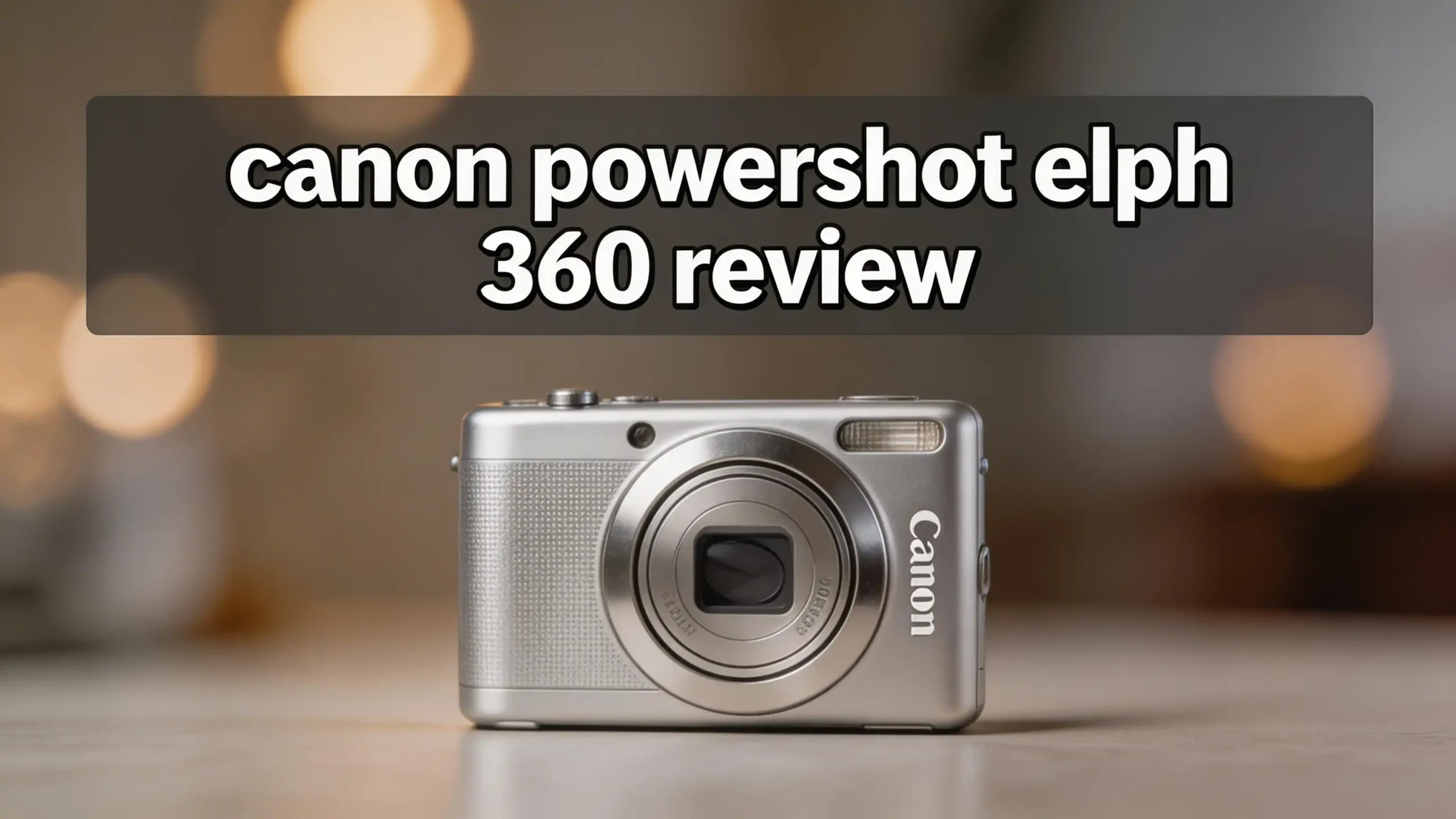
Canon PowerShot ELPH 360 Review 2026: Still Worth Buying?
The Canon PowerShot ELPH 360 HS has done something most cameras never do. It came back from the dead and became more popular than before. Canon originally released this camera in 2016 and then refreshed it in 2025 as the ELPH 360 HS A. It flew off shelves almost instantly.
This pocket camera weighs just 146 grams. It fits in a shirt pocket. It packs a 20.2MP sensor and a 12x optical zoom lens.
This review covers everything you need to know. We break down the specs, image quality, battery life, design, and real world performance.
Key Takeaways
- The Canon PowerShot ELPH 360 HS A uses a 20.2MP 1/2.3 inch CMOS sensor paired with the DIGIC 4+ image processor. This combination delivers solid photos in good light but shows limits in darker conditions. It shoots JPEG only. There is no RAW support.
- The 12x optical zoom provides a 25 to 300mm equivalent focal range. This gives you wide angle shots and distant subjects in one tiny package. The optical image stabilization offers about 2.5 stops of compensation, enough to shoot handheld at the telephoto end.
- Battery life is rated at 180 shots per charge using the NB-11LH battery. An Eco mode extends this to about 265 shots. This is below average for compact cameras, so carry a spare if you plan a long day out.
- Video recording tops out at Full HD 1080p at 30 frames per second. There is no 4K. The video quality falls well behind your smartphone. This camera is best used for still photos.
- Built in Wi-Fi lets you transfer images to your phone for quick social sharing. The camera also uses microSD cards instead of full size SD cards, a change from the original 2016 model.
- The price sits around $379.99, making it one of the most affordable compact cameras with a real optical zoom lens. It is frequently sold out due to strong demand from the compact camera revival trend.
Canon PowerShot ELPH 360 HS A: Design and Build Quality

- 12x Optical Zoom with Optical Image Stabilizer helps you capture images with flexibility and ease
- Built-in Wi-Fi and NFC allows for easy sharing and transferring of images and videos
Last update on 2026-10-24 / Affiliate links / Images from Amazon Product Advertising API
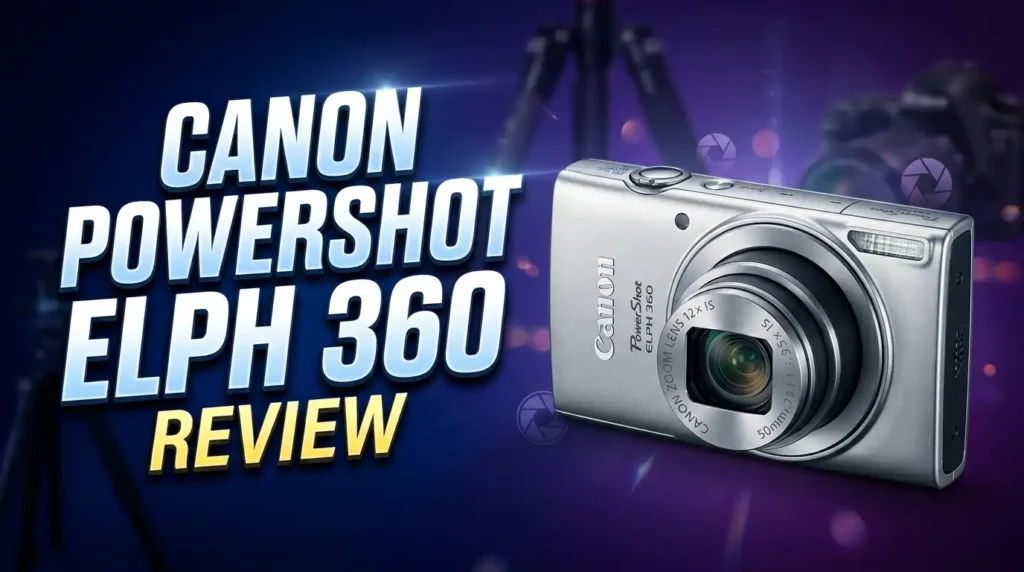
The Canon PowerShot ELPH 360 HS A is incredibly small. It measures just 99.6 x 58.0 x 22.8mm and weighs only 146 grams with the battery. You can slide it into a jeans pocket without noticing it.
The body features a smooth metal finish. Canon offers it in black and silver. The build feels solid for the price point. It does not feel cheap or flimsy.
The camera has a clean, minimal layout. There is a power button, a shutter button with a zoom rocker, and a mode switch on the top. The back panel has a few navigation buttons and a 3 inch LCD screen.
The screen displays 461,000 dots. It is bright enough for outdoor use in most conditions. It does not tilt or flip, which limits selfie shooting. But this is a classic point and shoot design, not a vlogging camera.
The microSD card slot sits next to the battery compartment on the bottom. This is a change from the original ELPH 360, which used full size SD cards. MicroSD cards are cheap and easy to find, so this is a minor adjustment.
Sensor and Image Processor Performance
The 20.2 megapixel 1/2.3 inch CMOS sensor is the heart of this camera. It captures good detail in bright daylight and well lit indoor scenes. Colors look natural, and sharpness is respectable for this sensor size.
Canon paired this sensor with the DIGIC 4+ image processor. This chip handles noise reduction, color processing, and autofocus. It works well for a budget compact, though it is several generations behind Canon’s latest processors.
ISO range spans from 80 to 3200. Images at ISO 80 to 400 look clean and detailed. Push above ISO 800 and you start to see noise and softness. ISO 3200 shots are usable at small sizes but lack fine detail.
The camera only records JPEG files. There is no RAW shooting. This limits how much you can adjust exposure and white balance in post production. You get what you get straight from the camera.
That said, the JPEG files hold up reasonably well to light editing. You can tweak contrast and clarity without destroying the image. Just do not expect the same flexibility as a RAW file from a larger sensor camera.
12x Optical Zoom Lens Explained
The built in lens covers a 25 to 300mm equivalent focal range. That gives you a true wide angle at one end and serious telephoto reach at the other. Very few cameras this small offer this kind of zoom range.
At the wide end, f/3.6 is the maximum aperture. At 300mm, it narrows to f/7.0. These are typical values for a compact zoom lens. The slower aperture at the telephoto end means you need more light for sharp handheld shots.
Optical image stabilization provides about 2.5 stops of shake reduction. This helps at longer focal lengths. You can shoot handheld at 300mm in decent light without major blur issues.
The lens also supports macro shooting with a minimum focus distance of just 1 cm at the wide angle setting. This lets you capture close up shots of flowers, food, text, and small objects.
There is also a 48x digital zoom, but the image quality drops sharply. Stick with the 12x optical zoom for the best results. Digital zoom is essentially cropping, and the 20.2MP sensor does not leave much room for it.
Top 3 Alternatives for Canon PowerShot ELPH 360 HS
If the Canon ELPH 360 does not fit your needs or your budget stretches further, these three compact cameras are strong options to consider.
1. Sony ZV-1

- 20.1MP stacked back illuminated 1” Exmor RS CMOS sensor w/ DRAM. Large aperture 24-70mm1 F1.8-2.8 ZEISS Vario-Sonnar T...
- Fast Hybrid Autofocus and Real Time Eye Autofocus and Real-time Autofocus tracking.
Last update on 2026-10-24 / Affiliate links / Images from Amazon Product Advertising API
The Sony ZV-1 offers a 1 inch sensor, which captures far more light than the ELPH 360’s 1/2.3 inch chip. It records 4K video and has a flip screen for vlogging. The price is significantly higher, but image quality jumps up considerably.
2. Canon PowerShot G7 X Mark III

- 20. 1 Megapixel 1. 0” stacked CMOS sensor and DIGIC 8 Image processor.
- 4.2x optical zoom Lens (24-100mm f/1. 8-2. 8) with optical image Stabilizer.
Last update on 2026-10-24 / Affiliate links / Images from Amazon Product Advertising API
If you want to stay with Canon, the G7 X Mark III delivers a 20.1MP 1 inch sensor with 4K video and a flip screen. It costs more but offers pro level image quality in a still compact body.
3. Ricoh GR IIIx

- GR with a 40mm angle of view: A focal length of 40mm provides a highly versatile angle of view that is close to the...
- The ultimate snapshot camera-GR unchanging concept: High image quality, Quick response, Portability, and Evolving

Last update on 2026-10-24 / Affiliate links / Images from Amazon Product Advertising API
The Ricoh GR IIIx packs a 24MP APS-C sensor into a pocket sized body. It shoots RAW, and the 40mm f/2.8 lens delivers outstanding image quality. It lacks a zoom lens, but image quality is in a completely different league.
Autofocus System and Speed
The Canon ELPH 360 HS A uses a 9 point AiAF system with face detection. The camera identifies faces in the frame and locks focus on them. This works well for group shots and casual portraits.
In bright light, the autofocus locks quickly and accurately. The camera acquires focus in less than a second most of the time. It performs well for a point and shoot camera at this price.
In low light, focus speed slows down. The camera sometimes hunts for focus, especially at the telephoto end. This is expected from a compact camera with contrast detection autofocus.
There is also a face detect auto zoom feature. The camera can zoom in or out based on the number of faces it detects. It widens the frame for group shots and zooms in for solo portraits. This is a fun and useful automatic feature.
Continuous shooting reaches 2.5 frames per second at full resolution. A 5MP crop mode bumps this to 7.2 fps. Neither speed is fast enough for serious action photography. But for everyday snapshots, it works fine.
Video Recording Capabilities
Video is the weakest area of this camera. It records Full HD 1080p at 30 frames per second. There is no 4K recording. There is no slow motion option.
The video quality looks soft compared to a modern smartphone. Colors are acceptable, but detail is limited. Audio comes from a built in mono microphone, and quality is basic.
One standout feature is Hybrid Auto mode. The camera records short video clips before each photo you take. It then stitches these clips into a highlight reel of your shooting session. This creates a fun behind the scenes video of your day.
There is a 29 minute 59 second recording limit per clip. This is a common limitation in many cameras due to file size restrictions.
If video is important to you, look elsewhere. The Sony ZV-1 or even your smartphone will deliver much better results. The Canon ELPH 360 is a still photography camera first and everything else second.
Battery Life and Charging
The Canon ELPH 360 HS A uses the NB-11LH lithium ion battery. Canon rates it at 180 shots per charge under standard testing conditions. An Eco mode extends this to approximately 265 shots.
This battery life is below average for compact cameras. Heavy zoom use and frequent LCD review drain the battery faster. You can realistically expect around 150 to 200 shots in a full day of casual shooting.
The camera charges via a dedicated wall charger included in the box. There is no USB charging. This means you cannot top up the battery with a power bank on the go.
Carrying a spare NB-11LH battery is strongly recommended. Third party batteries are inexpensive and widely available. A spare gives you peace of mind for travel days and longer outings.
The battery compartment sits on the bottom of the camera. It shares space with the microSD card slot. Swapping batteries takes just a few seconds.
Wi-Fi Connectivity and Sharing
Built in Wi-Fi (2.4GHz) lets you connect the camera to your smartphone. You can transfer images wirelessly using the Canon Camera Connect app. The app is available for both iOS and Android.
The transfer process is straightforward. Connect to the camera’s Wi-Fi network, open the app, and browse your images. You can select individual photos or transfer batches.
Image transfer speeds are decent but not instant. A full resolution JPEG takes a few seconds to move. Transferring a large batch of photos requires patience.
The original ELPH 360 included NFC for quick pairing. The updated HS A model uses Wi-Fi only. This simplifies the connection process but removes the tap to pair convenience.
You can also use Wi-Fi for remote shooting. The app lets you trigger the shutter from your phone. This is useful for group photos, tripod shots, and any situation where you do not want to touch the camera.
Who Should Buy the Canon PowerShot ELPH 360?
This camera fits a specific type of user. If you want a small, affordable, easy to use camera with a real zoom lens, the ELPH 360 delivers exactly that.
Travelers benefit from the tiny size and 12x zoom. It fits in any bag or pocket. The zoom range covers wide landscapes and distant landmarks. You do not need to carry extra lenses.
Parents and families get a simple camera for everyday moments. The auto modes handle exposure and focus. Just point and press the shutter button.
Street photographers appreciate the low profile. This camera does not attract attention. It boots up fast and fires instantly. You can capture candid moments without anyone noticing.
This camera is not ideal for serious photographers who need RAW files. It is not suited for video creators. And if you already have a flagship smartphone with a good camera system, you may not see a significant advantage.
Canon ELPH 360 vs. Your Smartphone
This is the question everyone asks. And the answer depends on what you shoot. The ELPH 360 offers a true 12x optical zoom that no smartphone can match without quality loss. Phone zoom relies on digital cropping or small periscope lenses.
The dedicated shutter button on the ELPH 360 gives a real camera feel. It responds instantly. There is no touch screen lag or accidental taps.
However, your smartphone wins in several areas. Modern phones capture better low light photos through computational photography. They shoot 4K video. They offer instant editing and sharing. And you already carry one.
The ELPH 360 complements a smartphone rather than replacing it. Use your phone for video, low light, and quick social posts. Use the Canon for zoomed shots, travel photos, and any time you want a dedicated camera experience.
The compact camera revival trend exists because people want that experience. Sometimes you want a device that does one thing well, not everything at once.
Image Quality in Real World Conditions
In bright daylight, the Canon ELPH 360 produces sharp, colorful images. Fine details in buildings, landscapes, and foliage come through clearly. White balance is accurate in most outdoor conditions.
Indoor shots require more care. The small sensor and slow aperture mean the camera pushes ISO higher. Images above ISO 800 show visible noise. The built in flash helps for close subjects but falls off quickly.
Contrast can appear flat straight out of camera. The auto exposure system tends to produce evenly lit images that lack punch. A quick contrast and clarity boost in any editing app brings images to life.
Color accuracy is generally good. Canon’s JPEG processing delivers pleasant skin tones and natural greens. Occasional white balance errors can introduce a slight magenta tint, but this is rare.
The macro mode performs well for close ups. You can get as close as 1 cm at the wide end. This is great for food photography, flowers, and product shots.
Creative Modes and Special Features
The ELPH 360 HS A includes several creative shooting modes that add variety. Creative Shot takes three exposures and generates six different versions of the same scene. Each version applies a different effect, from black and white to vivid color.
Scene modes include options for fireworks, snow, low light, and more. These preset configurations adjust the camera settings for specific situations. They work well for beginners who do not want to learn manual settings.
A fisheye effect and toy camera effect add fun, stylized looks. These apply in camera. Since there is no RAW file, the effect is permanent. Choose carefully before shooting.
The monochrome mode is genuinely useful. Black and white images from this camera have a pleasant tonal range. Street photographers and casual users can enjoy this without any post processing.
Program mode gives more control. You can adjust ISO, exposure compensation, and metering. This is enough for intermediate users who want slight adjustments without full manual control.
Pricing and Value for Money
- 12x Optical Zoom with Optical Image Stabilizer helps you capture images with flexibility and ease
- Built-in Wi-Fi and NFC allows for easy sharing and transferring of images and videos
Last update on 2026-10-24 / Affiliate links / Images from Amazon Product Advertising API
The Canon PowerShot ELPH 360 HS A retails at $379.99 in the United States. This places it well below premium compacts like the Fujifilm X100VI ($1,599) or the Sony ZV-1 ($748).
For that price, you get a 20.2MP sensor, 12x optical zoom, image stabilization, Wi-Fi, and a built in flash. That is a solid feature set for under $400. No other camera at this price offers this zoom range in such a small body.
The original 2016 ELPH 360 HS sold for about $230 at launch. The updated HS A model costs more and loses the SD card slot in favor of microSD. Some users find this frustrating.
Availability remains a challenge. The camera sells out frequently at major retailers. Demand has stayed high since its 2025 relaunch. If you find one in stock, act quickly.
For budget buyers who want a true camera experience beyond their phone, the ELPH 360 delivers strong value. It is not perfect, but it does its job well at a fair price.
Final Verdict: Should You Buy the Canon PowerShot ELPH 360 in 2026?
The Canon PowerShot ELPH 360 HS A earns its place as one of the best budget compact cameras available right now. It is tiny, simple, and capable for everyday photography.
The 12x optical zoom sets it apart from phones. The 20.2MP sensor delivers good images in decent light. The price is right for casual shooters, travelers, and families.
The downsides are real. No RAW support, weak video, modest battery life, and a sensor that struggles in low light. These are trade offs you accept at this price point.
If you want a camera that fits in your pocket and takes solid photos with real zoom, the Canon ELPH 360 is an excellent choice. It does not try to be everything. It just does the basics well, and sometimes that is exactly what you need.
Frequently Asked Questions
Is the Canon PowerShot ELPH 360 HS discontinued?
The original 2016 model was discontinued. Canon relaunched it as the ELPH 360 HS A in late 2025. This updated version is currently in production and available at major retailers, though it sells out frequently.
Does the Canon ELPH 360 HS shoot RAW photos?
No. The Canon ELPH 360 HS and HS A models only shoot JPEG images. There is no RAW file support. This limits post processing flexibility compared to cameras that offer RAW.
Can I charge the Canon ELPH 360 with USB?
No. The Canon ELPH 360 HS A uses a dedicated wall charger for the NB-11LH battery. It does not support USB charging. You cannot charge it with a power bank or USB cable.
Is the Canon ELPH 360 good for video?
The Canon ELPH 360 is not recommended for video. It records Full HD 1080p at 30fps only. There is no 4K. Video quality is soft and falls behind modern smartphones. Use this camera for still photography.
What memory card does the Canon ELPH 360 HS A use?
The updated HS A model uses microSD, microSDHC, or microSDXC cards. The original 2016 model used full size SD cards. Make sure you have a microSD card and compatible reader before purchasing.
How does the Canon ELPH 360 compare to the iPhone camera?
The Canon ELPH 360 offers a true 12x optical zoom that iPhones cannot match. It delivers better zoom quality at longer focal lengths. However, iPhones produce better low light photos, 4K video, and offer instant editing tools. The two devices complement each other well.

Hi, I’m Emma! I’m that friend who always gets asked “Should I buy this gadget?” – and I love it. After years of being the unofficial tech advisor for family, friends, and coworkers, I realized I had a knack for cutting through marketing hype to find what actually works.